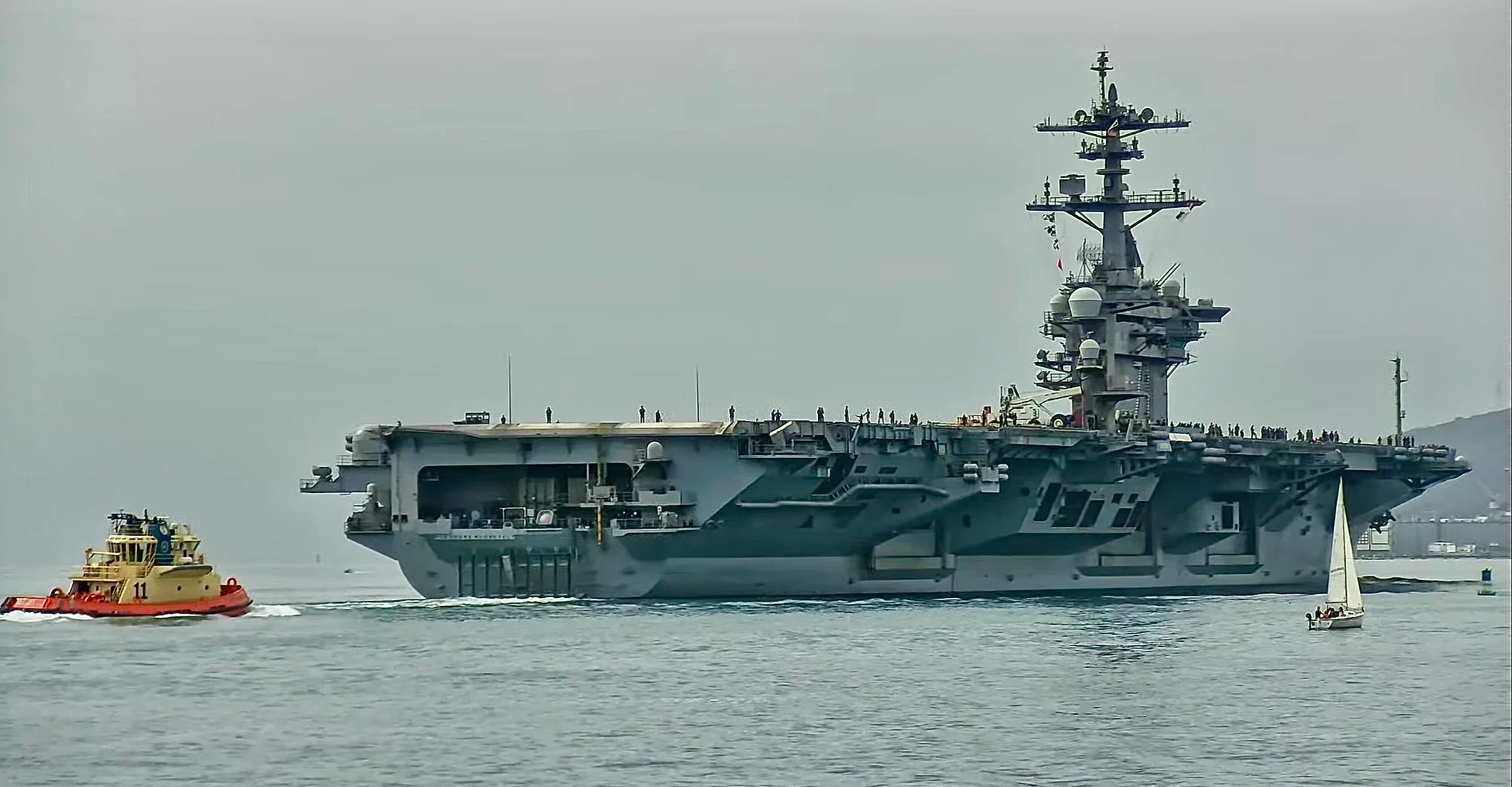
Photo: USNI, @SanDiegoWebCam, 27 September 2026
The United States is once again reinforcing its military presence around Iran, with the USS Theodore Roosevelt heading towards the Middle East as part of a wider rotation of US naval forces. Rather than remaining indefinitely alongside the USS George Washington, the Theodore Roosevelt is expected to help replace it and sustain carrier coverage without repeating the exceptionally long deployment experienced by the USS Abraham Lincoln.
The Lincoln spent more than nine months deployed, including 286 days at sea, generating criticism from sailors’ families and members of Congress over morale, living conditions and mental-health pressures. The George Washington was subsequently sent to relieve it, and the arrival of the Theodore Roosevelt suggests Washington is seeking to maintain a strong regional presence while rotating crews more regularly.
- The USS Theodore Roosevelt is heading towards the Middle East with its carrier strike group.
- It is expected to help relieve the USS George Washington rather than create a permanent three-carrier presence.
- The George Washington itself was deployed to relieve the USS Abraham Lincoln after its unusually long Middle East mission.
- The Lincoln’s extended deployment prompted criticism over crew fatigue, morale, family separation and mental-health concerns.
- Successive carrier rotations allow Washington to maintain naval coverage without keeping the same crews deployed for unusually prolonged periods.
- The latest movement comes only weeks before the US midterm elections on 3 November.
The more important strategic issue, however, is not simply how many aircraft carriers Washington can deploy at any one time. The United States retains overwhelming conventional military superiority, but Iran’s geographical position gives it considerable de facto control and influence over access through the Strait of Hormuz. Additional carriers provide Washington with greater firepower and operational flexibility, while regular rotations may reduce the personnel pressures exposed by the Abraham Lincoln deployment. They do not, however, alter the basic geography of the confrontation. As long as Iran retains its position around Hormuz, US military superiority will continue to coexist with significant Iranian leverage over one of the world’s most important maritime and energy corridors.
Author: Mikael Darbinian is a former US diplomat, geopolitical and military analyst and founder of Security Observer. He specialises in foreign policy analysis, military affairs and international security.