Photo: AP Photo/Mohnd Blal
Across the continent, armed conflicts follow a recurring script: a contested claim to power, foreign sponsors who supply the means, and war economies that make fighting pay. Peace efforts that address only one of the three will keep failing.
On 18 October, at least 139 people were killed when a transport truck in Dibab, West Kordofan, was hit twice in quick succession by drones, according to the United Nations. The strike was one of several that killed at least 306 people in three weeks. The UN human rights chief noted that armed drones already account for the majority of conflict-related civilian deaths in Sudan this year. The attack barely registered in international headlines.
That silence is the problem. Sudan is now the deadliest conflict in Africa, ranked by ACLED alongside Ukraine, Syria and Gaza, and ACLED expects Sudan, Ethiopia, Nigeria, Somalia and Burkina Faso to lead the continent’s violence tables in 2026. The International Crisis Group has flagged seven arenas that demand urgent diplomacy, from the Sahel to the Great Lakes. Counts of “active conflicts” vary with definitions, but the structure behind them does not. Look closely and the same three forces appear almost everywhere: the throne, the patrons and the treasury.
The throne: who rules, and who may bear arms
At the root of most of these wars is an unresolved question of power. When the republican compact fails, the state stops being the referee and becomes a combatant.
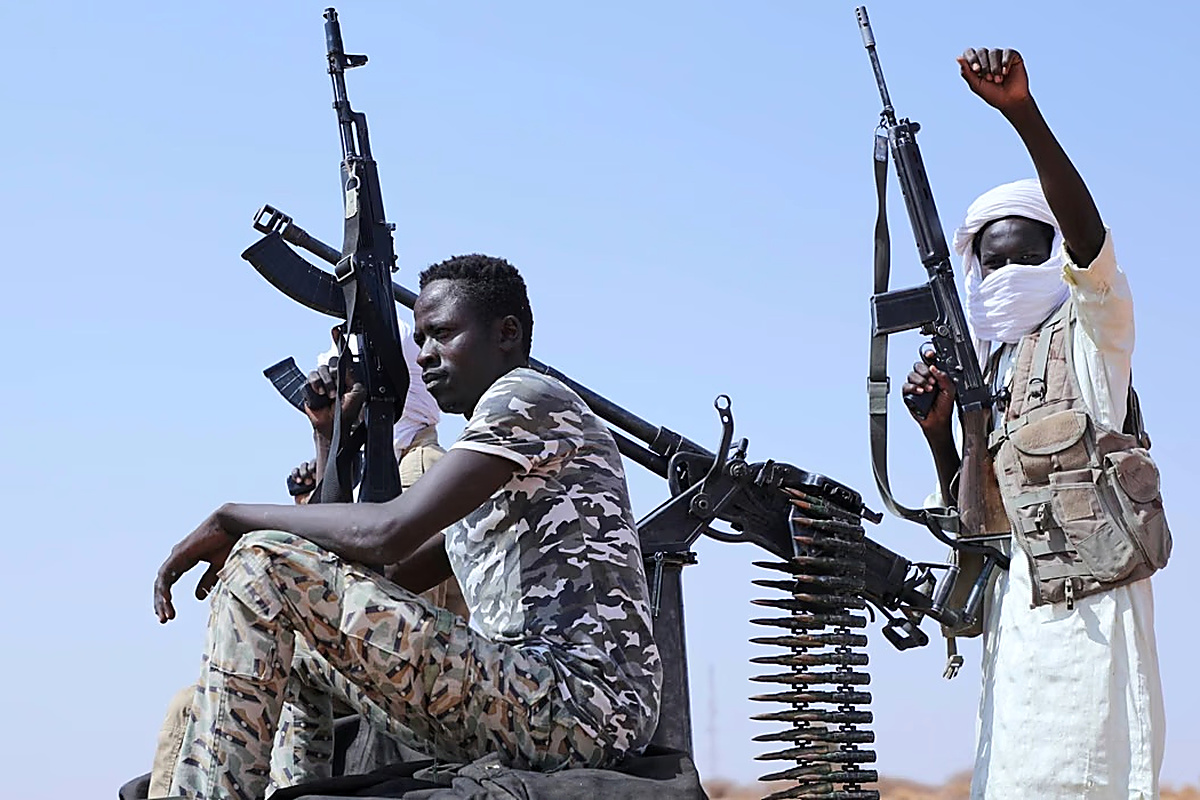
Sudan is the starkest case. The war began in April 2023 as a power struggle between the army and the Rapid Support Forces (RSF) ahead of a planned transition to civilian rule. A paramilitary force that was supposed to be absorbed into the national army ended up fighting it. The army has since retaken Khartoum, while the RSF captured El Fasher on 26 October 2025 after an 18-month siege. Famine conditions have been confirmed in El Fasher and Kadugli.
Somalia shows the same logic in a different register. In March 2026 the president signed constitutional amendments extending presidential and parliamentary terms from four to five years, which pushed elections to 2027. The opposition, backed by the Puntland and Jubaland administrations, calls this a constitutional coup. Mediated talks collapsed in mid-May, and armed clashes between government forces and opposition militias followed in Mogadishu in early June. In Ethiopia, the TPLF’s move to reinstate its 2020 regional government has revived fears for the fragile peace in Tigray, as ACLED has noted.
Where the rules of succession and the control of armed forces are contested, the gun fills the space that compromise should occupy. The African Union, whose peace and security architecture Crisis Group describes as suffering from a deep malaise, has too often been a spectator.
The patrons: local wars, foreign hands
Very few of these wars stay local. External backers supply weapons, technology and sometimes fighters, and they turn domestic power struggles into proxy contests that mediators struggle to unwind.
The UN’s Independent International Fact-Finding Mission for Sudan set this out on 3 September 2026. It found reasonable grounds to believe that a transnational network operating across Colombia and the United Arab Emirates, with transit points in Chad, Libya and Somalia, supplied the RSF with weapons, logistics, training and foreign personnel. It documented around 2,000 Colombian contractors, some of them operating drones and advanced weapons. The UAE rejects the allegations and Chad says it is neutral. The Mission also found that foreign-supplied drones have expanded the army’s long-range strike capability, although it describes those findings as preliminary. This is not a one-sided story.
The diplomatic consequence is visible. Khartoum insists the RSF withdraw and disarm before any truce, while Washington, leading the Quad with Saudi Arabia, the UAE and Egypt, presses for a truce without preconditions. With patrons on both sides of the line, each belligerent can afford to wait.
The pattern recurs. In eastern DR Congo, UN experts have documented Rwandan military support for the M23, which Kigali denies, while Burundian forces operate in South Kivu alongside Kinshasa. Washington sanctioned the Rwanda Defence Force on 2 March 2026. The Washington Accords between the DRC and Rwanda (December 2025) and the Doha Framework between Kinshasa and the M23 (November 2025) have not stopped the fighting. Security Council Report says clashes have continued unabated, and the UN’s own envoy admits the security and humanitarian situation has kept worsening. In Mali, the junta replaced French forces with Russian mercenaries, formerly Wagner and now branded Africa Corps. Africa’s wars are again a stage for global and regional rivalries, and sovereignty is usually the first casualty.
The treasury: wars that pay for themselves
Money is rarely the spark. It is the fuel that keeps the fire going, and a war that finances itself has little reason to end.
A July 2026 report from the UN Office of the High Commissioner for Human Rights (OHCHR) found that gold sales are a major revenue source for both the army and the RSF, and that nearly 48 per cent of Sudan’s 2024 gold output was smuggled out of the country. Gum arabic adds supporting liquidity. Before the war Sudan supplied 70 to 80 per cent of global crude exports of this ingredient, used in soft drinks, cosmetics and pharmaceuticals, and the report traces RSF-held stocks through Souq al-Na’am into South Sudan and on to Mombasa. The UN rights chief’s message was blunt: this war economy must be disrupted, and companies cannot keep sourcing from these value chains as if nothing had happened.
In eastern Congo, UN experts report that the M23 continues to expand its control over mines producing gold, tin, coltan and other minerals, and to smuggle the output to Rwanda. In the Sahel, the jihadist coalition JNIM has turned fuel into a weapon: its blockade of Bamako, launched in September 2025, targeted tanker convoys and squeezed a junta that had promised security.
These economies connect the continent’s war zones to refineries, traders, ports and consumers well beyond Africa, in the Gulf, in Europe and in Asia. Those buyers are part of the war’s supply line, whether they know it or not.
Three priorities for mediators and partners
If the diagnosis is right, mediation that treats only the battlefield will keep producing ceasefires that do not hold. Three shifts follow.
- First, treat contested mandates and armed-force integration as early-warning signals, not domestic affairs. Term extensions, parallel security forces and stalled integration deals preceded violence in Sudan and Somalia. African regional bodies are best placed to act before the shooting starts, but only if member states accept that mandate disputes are a legitimate subject of collective concern.
- Second, enforce arms embargoes and sanction the intermediaries. The Fact-Finding Mission has called on states to enforce the Darfur arms embargo and on the Security Council to extend it to the whole of Sudan. Sanctions should target the brokers, recruiters, shippers and component suppliers who keep drones flying, whoever their sponsors are, and they should apply to every side.
- Third, trace and regulate the commodity chains. Mandatory due diligence for gold, gum arabic and critical minerals, with transit and refining hubs held to the same standard, would raise the cost of financing war. Several of these hubs sit in countries that are also mediators, which is exactly why transparency matters.
The honest caveats
None of this is quick or risk-free. Embargoes are only as strong as the states that enforce them, and several of those states are the patrons. Smuggling routes adapt faster than sanctions lists. Evidence on external support varies: it is detailed for the RSF and still preliminary for the army, and any credible policy has to say so. A humanitarian truce, the immediate priority in Sudan, cannot wait for structural reform, and structural reform cannot be replaced by a truce. The two are complements, not substitutes. Finally, headline counts of conflicts differ between ACLED, UCDP and Crisis Group, so policymakers should be wary of any single figure presented as definitive.
These are arguments for sequencing and design, not for inaction. The cost of the status quo is counted in strikes on markets, besieged cities and children trained to fight.
From invisible wars to shared responsibility
The African challenge is not only military or humanitarian. It is political, ethical and systemic. Africans are not passive victims of external design: local elites choose to extend mandates, to integrate or sideline armed groups, and to monetise resources. But they do so within a market for weapons, mercenaries and commodities that is global. Until the throne, the patrons and the treasury are confronted together, these wars will remain invisible to the world and endless for those who live through them.
Dr Nizar Chaari is a senior consultant, strategist and media executive with over 30 years of experience in media, public affairs and pan-African leadership engineering. He is President of Tunivisions Group and founder of the Tunivisions Foundation and EPIK Leaders, a pan-African youth movement active in 15 countries. He specialises in grand strategy, digital transformation and organisational leadership.