Photo: Italian Navy
Europe’s border-first approach treats the symptoms of youth hopelessness in the Maghreb while its political and economic drivers deepen. A durable Mediterranean security strategy has to start with agency — and with honesty about where power lies.
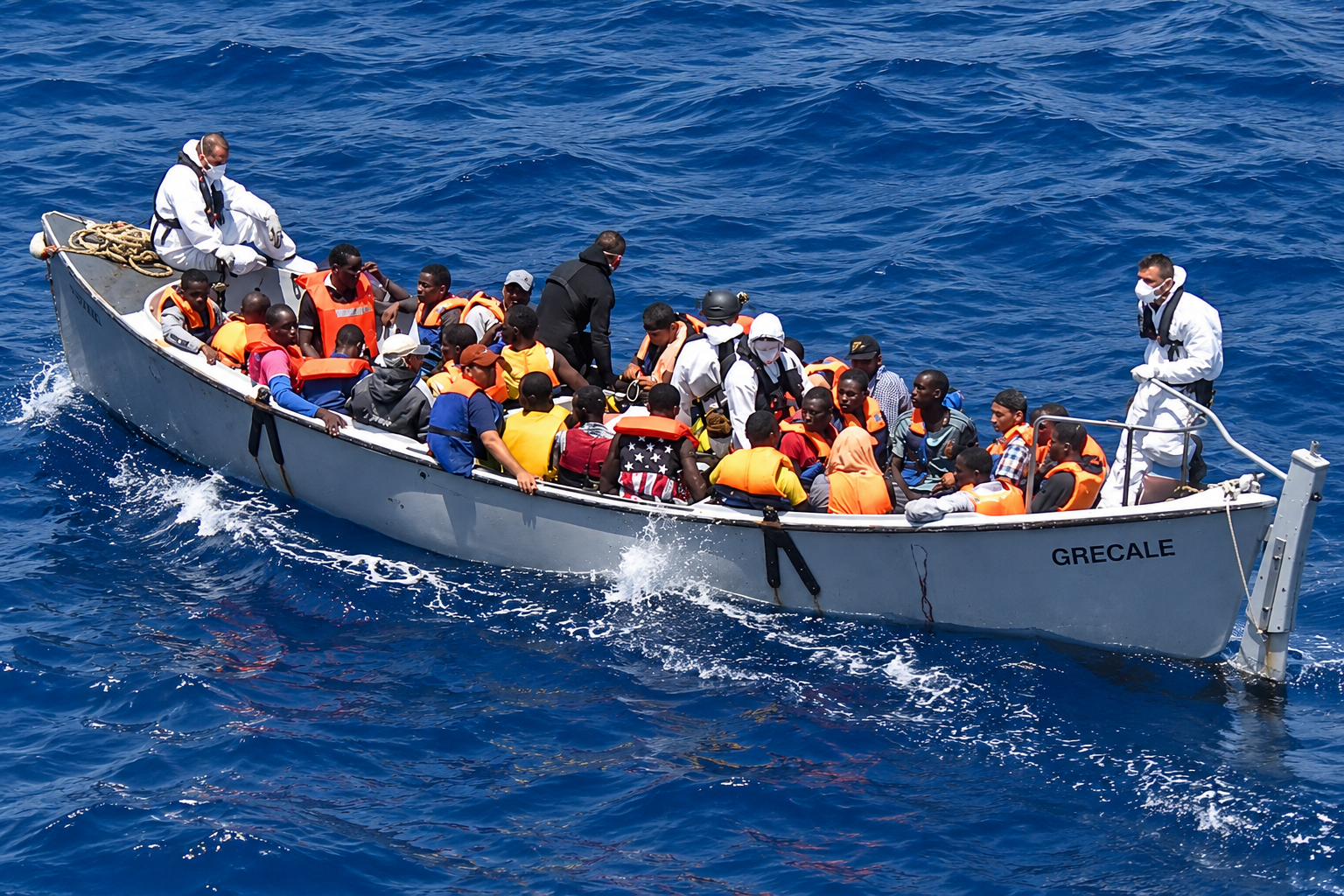
In late August, a boat carrying 15 people from Tunisia’s south-east sank on its way to Italy. At least 12 died — 14 of the 15 on board were residents of Ben Guerdane, a border town where informal and illicit trade has long substituted for a formal economy. That night, residents burned tyres, blocked roads and clashed with security forces. The central Mediterranean route has claimed at least 821 migrant lives or disappearances in 2026, according to the International Organization for Migration, more than double the toll for the same period of 2025. (More than half of those deaths came in January, when Cyclone Harry struck; strip the storm out, and the route is still deadlier than it was.)
This is the pattern European capitals keep misreading. Tunisia has also seen recurring self-immolations, grim echoes of Mohamed Bouazizi’s act in 2010. The Tunisian Forum for Economic and Social Rights, through its Social Observatory, counted 1,316 protest movements between July and September 2025 — nearly double the level of the same period in each of the previous two years, and concentrated in the inland and border governorates, from Gafsa to Kasserine to Ben Guerdane itself, that supply both protest and departures. Unions have shut down banks and called national strikes. Each episode is treated as a local public-order problem. Taken together, they are the most reliable available signal that the social contract is failing — in a country that has been under a renewed state of emergency since early this year.
A security problem, not only a social one
European policy toward the Maghreb remains overwhelmingly defined by one question: how many people reach the northern shore? Border management is a legitimate priority, and no serious analyst argues otherwise. But a policy that measures success only by departures counted at sea mistakes the thermometer for the fever.
The underlying condition is the collapse of social mobility and of trust in institutions — and the second of these has a political cause as much as an economic one. Since President Kaïs Saïed’s concentration of power in July 2021, formal channels of dissent have narrowed: a cybercrime decree has been wielded against journalists and opposition figures, and the space for associations and independent media has shrunk. North Africa’s young people are, on average, better educated and more digitally connected than any previous generation, yet they face rigid administration, an informal economy estimated at around two-fifths of GDP, thin private-sector hiring and few legitimate routes to advancement. When every path to dignity looks closed, the responses converge on two outlets: despair expressed at home, or a dangerous crossing abroad. Both draw on the same source.
The security consequences are tangible. Neglected border economies are smuggling economies: Ben Guerdane’s illicit trade predates the current crisis and finances networks that outlast any single migration deal. Young people without prospects are more exposed to these networks and to the criminal groups that tax them. Recurrent unrest erodes state capacity at precisely the moment when outside powers — Russia cultivating overstretched security services, China lending against strategic assets — are courting governments that Brussels prefers to lecture. And instability in Tunisia would not stay in Tunisia: its coastline is the EU’s shortest maritime frontier, and its collapse would land on Europe’s shores within weeks.
Why the current model is failing
The prevailing toolkit combines border-containment arrangements — the 2023 EU–Tunisia memorandum of understanding, backed by €105 million for coastguard and border management — with macro-financial assistance that has remained largely undisbursed in the absence of an IMF programme, and with short-term financing tied to fiscal consolidation. Both have a logic. Neither addresses the push factors. Austerity that trims public services without unlocking private initiative adds to social friction; the UGTT’s bank strikes are, in part, a verdict on that arithmetic. Outsourced border enforcement can reduce departures for a time, but it shifts routes, raises the human cost of crossing and leaves partner governments carrying the political burden of policies many of their citizens resent. The 2023 wave of violence against sub-Saharan Africans in Sfax showed the domestic price of making Tunisia Europe’s outboard engine. And crossings are not falling in a way that suggests the strategy is working: the IOM toll cited above points the other way.
Three priorities for a New Mediterranean Deal
First, redirect capital toward youth enterprise — and this time fix the absorption problem. Tunisia already has a Startup Act, youth-employment agencies and guarantee schemes; what has been missing is scale, transparency and reach beyond well-connected incumbents. European and international financial institutions should move from passive aid toward instruments that reach young entrepreneurs directly — guarantee schemes, early-stage and growth finance, streamlined trade access — with transparent procurement, independent monitoring and local intermediaries as non-negotiable design features. A deliberate focus on marginalised inland and border regions such as Kasserine, Sidi Bouzid, Gafsa and Ben Guerdane would target the areas that supply both protest and departures. The EU’s Global Gateway and neighbourhood instruments offer a chassis; they need an anti-capture engine.
Second, invest in institutions and skills rather than only in enforcement. Simpler licensing, predictable regulation and functioning local administration matter as much to stability as patrol boats — and so does the political plumbing around them: independent courts, a viable law on associations, and room for the UGTT and civil society to do the daily work of representation that, when suppressed, reappears as unrest. University incubators, vocational training tied to real employers and leadership networks give young people a tangible reason to build futures at home. Where central governments block reform, Brussels should channel support directly to municipalities, universities and professional associations rather than suspend engagement altogether. Support should be tied to measurable reform outcomes, not only to migration metrics.
Third, organise mobility instead of pretending it can be eliminated. Structured legal pathways for study, skilled work and joint ventures can convert uncontrolled “brain drain” into managed “brain circulation”. The EU’s Talent Partnerships with Morocco, Tunisia and Egypt, launched in 2023, are a first framework, but they remain small relative to the scale of demand. Scaling them — with credible return and recognition mechanisms, employer-led selection and honest communication to European publics — would also strengthen cooperation on irregular migration by giving Tunisian leaders something to show their own citizens.
The honest caveats
None of this is quick or risk-free. Economic empowerment takes years to show results, while political cycles in Europe reward immediate numbers. Investment can be captured by incumbents unless it is transparent and monitored — a risk this strategy takes seriously, not a footnote. Legal mobility schemes will be contested in electorates already anxious about migration; the answer is design and sequencing, not silence. Conditionality, meanwhile, cuts both ways: fiscal targets that hollow out the schools and clinics young Tunisians depend on feed the very despair this strategy aims to relieve. And border control and development are complements, not substitutes: a credible deal needs both, with enforcement maintained while the deeper work proceeds.
These are arguments for sequencing and design, not for inaction. The cost of the status quo is measured in drowned young people, burned tyres and a southern shore that grows less stable each year.
From buffer zone to partner
The region’s young people are asking for dignity, agency and a stake in their own future. If European and international partners want durable stability in the Mediterranean, they must stop treating the southern shore as a buffer zone and start treating its rising generation as partners in a shared security — including, where necessary, as partners in pressing their own governments for the reforms that make agency possible. The alternative is to keep managing the symptoms until they can no longer be managed.
Dr Nizar Chaari is a senior consultant, strategist and media executive with over 30 years of experience in media, public affairs and pan-African leadership engineering. He is President of Tunivisions Group and founder of the Tunivisions Foundation and EPIK Leaders, a pan-African youth movement active in 15 countries. He specialises in grand strategy, digital transformation and organisational leadership.