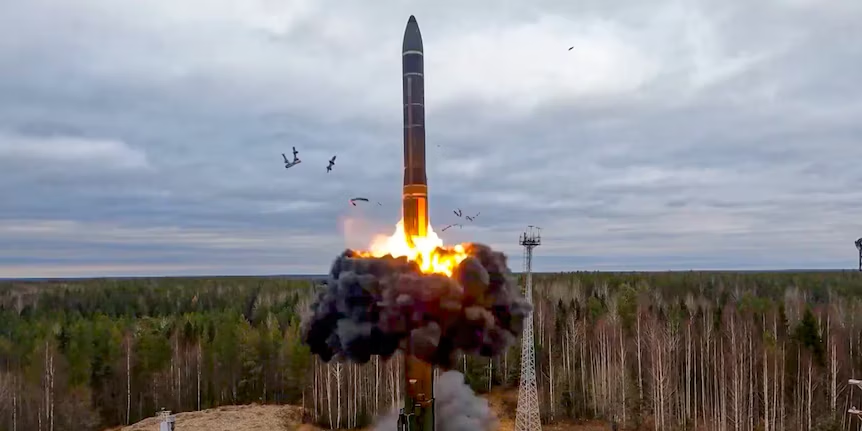
The Oreshnik is presented by Moscow as a new-generation Russian ballistic missile with hypersonic characteristics and a high level of difficulty for interception. In technical terms, it is described as an intermediate-range ballistic missile, with an estimated speed of around Mach 10, or approximately 12,000 km/h. Its reported ability to carry either conventional or nuclear payloads gives it a dual-use profile, which is important because the same delivery system can carry very different types of warhead depending on the intended military or strategic effect.
Its reported use against the Lvov region, close to the Polish border, gives the event a strategic dimension beyond the immediate target. Lvov is geographically significant because of its position in western Ukraine and its proximity to NATO territory. For that reason, the use of a system such as Oreshnik in this area can be interpreted as a signal towards Western states, particularly those involved in supporting Ukraine militarily or discussing future security arrangements. The missile therefore functions not only as a strike system, but also as a tool of strategic communication.
The timeline is also important. According to the text, this would be the second reported use of Oreshnik since 21 November 2024, when its first use was recorded after a major turning point in the conflict: Joe Biden’s authorisation for Volodymyr Zelensky to use ATACMS missiles against targets inside Russian territory, alongside the first recorded use of British Storm Shadow missiles against Russia. In that context, the renewed appearance of Oreshnik can be read as part of an escalation cycle, where long-range Western-supplied systems and Russian ballistic capabilities are used to shape perceptions of risk.
From a technical perspective, the most relevant issue is not whether Oreshnik is literally “invisible to radar” or absolutely “impossible to shoot down”. A more precise assessment is that ballistic missiles travelling at very high speed reduce the time available for detection, tracking, decision-making and interception. The challenge for air defence lies in the compressed reaction window, the missile’s ballistic trajectory, and the high-speed re-entry phase. Reports of a separable warhead with up to six elements, and possible submunitions, would further complicate tracking and interception if accurate.
The wider geopolitical message sits alongside these technical characteristics. The text refers to UK and French discussions about a possible multinational force in Ukraine after a future ceasefire, and to Russian warnings that foreign troops would be considered legitimate targets. It also links the issue to US actions under Donald Trump in relation to Venezuela, including the seizure of tankers connected to Venezuelan crude, and how Moscow might interpret this within its broader contest with Washington. In this reading, Oreshnik is not only a missile system, but a means of signalling capability, resolve and risk across several connected theatres.