Image: Hazim Al-Mulla, VesselFinder
A strategic assessment of the tanker attacks of 16–18 September 2026
The latest incidents involving commercial tankers in and around the Strait of Hormuz should not be examined simply as three separate attacks against three individual ships.
They represent something potentially more consequential: the progressive transformation of a vital commercial waterway into a high-risk, intelligence-driven maritime operating environment in which uncertainty itself has become a strategic weapon.
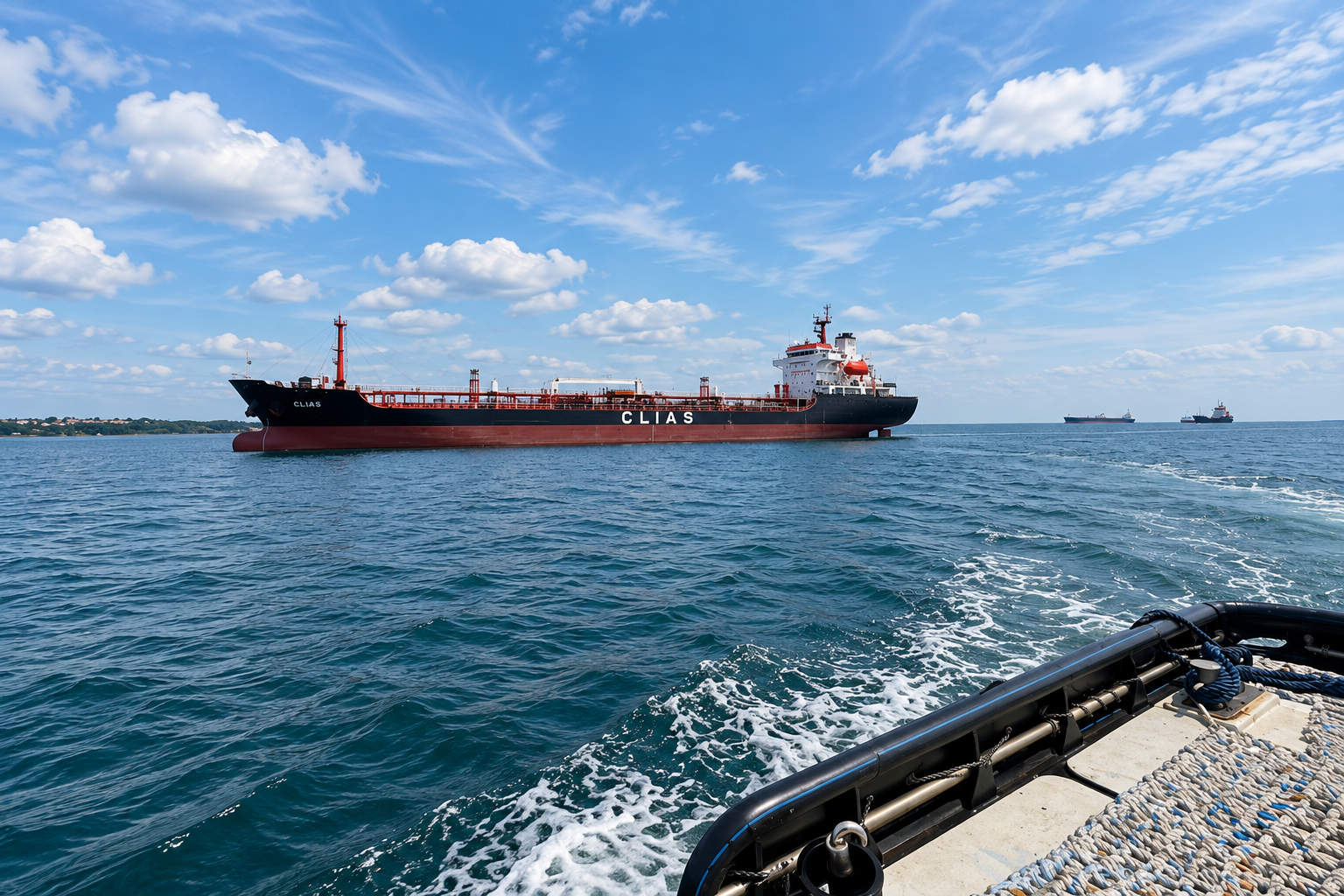
Between 16 and 18 September 2026, three tankers were reported attacked:
- MT BASRAH ENERGY — IMO 9391775 — 16 September
- MT TREND — IMO 9477177 — 17 September
- MT STI STEADFAST — IMO 9719719 — 18 September
The incidents occurred against a background of sharply reduced commercial traffic through Hormuz. Reuters reported on 21 September that only around a dozen commodity vessels transited during the preceding weekend, compared with 35 the previous weekend and a pre-war norm of approximately 125 large commercial vessels per day.
Core intelligence assessment
- That contrast is perhaps the most important intelligence indicator of all.
- The question is no longer simply who attacked which vessel.
- The more important question is: Has the threat environment become sufficiently credible to change the behaviour of the global maritime industry?
If the answer is yes, the strategic consequences extend far beyond the physical damage caused to individual ships.
1. Three attacks in three days: the pattern is the message
A sequence of maritime incidents occurring within a compressed 72-hour period deserves a different analytical treatment from isolated attacks.
The first incident involved MT BASRAH ENERGY, a Panama-flagged crude-oil tanker. Indian reporting, citing maritime authorities, said the vessel was struck by a projectile in the funnel area while sailing eastbound just outside the Strait. The vessel suffered no significant damage and reached Fujairah anchorage with 22 crew, including 14 Indian nationals.
MT TREND, a Togo-flagged product tanker, was subsequently reported attacked near Khasab, Oman. Iran’s Revolutionary Guard publicly claimed responsibility and said the vessel had attempted an unauthorised transit. Those claims should be distinguished from independently established facts about the incident.
The third vessel in the reported sequence was MT STI STEADFAST, IMO 9719719, attacked on 18 September according to the incident chronology provided for this analysis.
The critical intelligence point is not necessarily that all three attacks had the same perpetrator. At present, that conclusion would go beyond the available evidence. The significant feature is the concentration of attacks against commercial tanker traffic in the same strategic maritime theatre. That alone changes the risk calculation for every master, shipowner, insurer, charterer and maritime-security organisation operating in the region.
2. The real battlefield may be commercial confidence
Modern maritime conflict does not necessarily require the destruction of ships. A maritime actor can achieve strategic effects through:
- Uncertainty & intimidation
- Disruption & route denial
- Increased insurance costs & delayed voyages
- Electronic concealment & port congestion
- Crew evacuation & alteration of commercial behaviour
That distinction is crucial. A tanker that survives an attack may still become part of a much larger strategic consequence. If ten ships decide not to transit because of the perceived risk, the attacker has influenced maritime traffic without firing ten additional weapons. This is the concept of behavioural deterrence through uncertainty.
The available traffic data demonstrate why this matters. Reuters reported that visible traffic through Hormuz has fallen dramatically, with only a small number of commodity vessels crossing during the weekend of 19–20 September compared with pre-conflict traffic levels. Some Middle Eastern tankers have nevertheless continued to move while their transponders are switched off.
The strategic effect is therefore occurring at two levels:
- Physical level: ships are being attacked or threatened.
- Psychological/commercial level: other ships are reconsidering whether to transit.
The second effect may ultimately prove more consequential.
3. The AIS dilemma: safety versus survivability
One of the most difficult problems emerging from the current environment concerns Automatic Identification System — AIS. AIS provides authorities with essential information concerning vessel identity, position, course and movement.
But in a contested environment, electronic visibility can become a vulnerability. A ship broadcasting its identity and location presents a much clearer maritime picture to everyone operating in the area.
A vessel that switches off its AIS reduces its visible electronic signature — but simultaneously creates another problem. It becomes harder for legitimate maritime authorities to determine:
- Where it is and what it is carrying
- Where it is going and whether it has deviated from its declared route
- Whether it is experiencing an emergency or intentionally concealing its movement
This produces a dangerous intelligence paradox: The more ships attempt to become invisible for protection, the harder it becomes to maintain a reliable maritime picture.
Consequently, future maritime security cannot depend on AIS alone. A genuinely resilient maritime-domain-awareness architecture requires the integration of: AIS, coastal radar, satellite imagery, SAR, VTS, intelligence reporting, UAV surveillance, port data and human intelligence.
The objective is not simply to know where ships are. It is to understand why they are there and whether their behaviour is consistent with normal commercial activity.
4. The geography of vulnerability
Hormuz is particularly dangerous because geography compresses maritime movement. The Strait is a chokepoint. Ships cannot simply disperse across a vast ocean. Commercial traffic is concentrated into defined navigational corridors, creating what security professionals understand as a predictable operating environment. Predictability creates vulnerability.
The problem becomes more complicated when vessels are approaching or leaving the Strait through areas around: Khasab, Musandam, Fujairah, the Gulf of Oman and the wider Arabian Sea.
The security perimeter therefore cannot stop at the narrowest point of the Strait. A vessel may be vulnerable before entering, while transiting or after exiting. That is an important distinction for maritime planners. The concept of a “secure Strait” is insufficient. The appropriate concept is a security corridor extending across the approaches.
5. The weaponisation of uncertainty
One of the most sophisticated characteristics of the current maritime environment is uncertainty regarding attribution. When an incident occurs, analysts must distinguish between:
- Confirmed facts
- Crew or company reports
- Maritime authority advisories
- Military claims
- Intelligence assessments
- Information operations
That distinction is particularly important in the case of MT TREND. Iran’s Revolutionary Guard claimed that it had targeted the tanker because it considered the vessel’s passage unauthorised. Iranian officials presented the incident as evidence of control over the waterway.
Whether every element of that narrative is independently established is a separate question. But from an intelligence perspective, the statement itself matters.
Why? Because the communication surrounding an attack can be part of the attack’s strategic effect. A military actor does not necessarily need to control every square kilometre of a waterway to influence commercial behaviour. It may seek to create the perception that it can control who enters, who leaves and under what conditions. That perception can influence shipowners even when the physical enforcement capability remains contested.
6. The crew is becoming part of the strategic equation
The human dimension should not be underestimated. The Basrah Energy incident reportedly involved 22 crew members, including 14 Indian nationals. Indian authorities were also monitoring a larger group of vessels of Indian interest in the Gulf, with substantial numbers of Indian seafarers aboard.
This illustrates another important transformation. Maritime security is no longer only about:
- Ship
- Cargo
- Route
It is also about:
- Ship
- Crew
- Nationality
- Evacuation
- Diplomacy
- Medical support
- Family welfare
For major seafaring nations, attacks against commercial ships can quickly become a consular and political-security issue. Crew nationality therefore becomes a legitimate component of maritime risk analysis. A ship carrying a multinational crew may involve several governments if an incident occurs. The security incident at sea can rapidly become a diplomatic incident on land.
7. The energy-security dimension
The Strait of Hormuz has extraordinary importance to global energy markets. Its importance is amplified by the absence of easy substitutes. Reuters reported that Middle Eastern producers continue moving oil despite the security environment, while Saudi Arabia has increased exports through Gulf terminals following disruptions to its alternative East-West pipeline route.
This produces an extraordinary strategic contradiction. The security environment is deteriorating. Yet the requirement to move energy through the region remains.
In other words: The greater the risk, the greater the strategic pressure to keep the corridor functioning. That creates a high-value target environment. Commercial operators are effectively being asked to continue moving strategic cargo through a contested maritime space because the global economy still requires those commodities.
8. Ship-to-ship transfers: adaptation with new risks
Another important development is the expansion of ship-to-ship transfers. Reuters reported that producers have increasingly used STS operations near Oman to maintain oil flows, with volumes transferred through such arrangements reportedly rising significantly in September.
This demonstrates the remarkable adaptability of the energy industry. But adaptation also creates new security questions. Ship-to-ship operations introduce:
- Additional vessel interactions & extended exposure periods
- Navigation complexity & transfer risks
- Increased dependence on offshore coordination
- Additional opportunities for intelligence collection or interference
STS operations can therefore preserve energy flows while simultaneously creating a more complicated maritime security environment. The system becomes more resilient — but potentially more complex.
9. The Bab el-Mandeb–Hormuz connection
It would be a mistake to examine Hormuz independently from the wider regional maritime system. The Bab el-Mandeb is another critical chokepoint. Traffic there has also declined amid regional insecurity. Reuters reported that traffic through Bab el-Mandeb fell during the same period, while disruption to alternative Saudi export routes increased pressure on Gulf shipping.
This creates a strategic problem for global shipping. If one corridor becomes dangerous, shipping normally seeks an alternative. But if several interconnected corridors are simultaneously exposed to disruption, the system loses its ability to absorb shocks. The result is not simply a regional maritime-security problem. It becomes a global maritime resilience problem.
10. The Indian Ocean must watch the second-order effects
This is where the issue becomes directly relevant to Indian Ocean security. Mauritius, Seychelles, India, Oman, the UAE and other regional maritime states operate within an interconnected maritime system.
A prolonged disruption in Hormuz can produce:
- Route changes
- Altered tanker patterns
- Increased anchorage activity
- Increased port calls
- Additional bunkering demand
- Greater security screening
- New trafficking opportunities
The maritime-security community should therefore avoid looking only for direct attacks. The more subtle indicator may be abnormal vessel behaviour. A vessel suddenly changing destination, AIS behaviour, speed, anchorage, ownership, cargo pattern or port rotation may represent nothing more than commercial adaptation. But a cluster of such anomalies can become an intelligence signal.
11. What maritime authorities should monitor
A professional maritime-security watch should establish a continuously updated incident matrix covering:
- Vessel Intelligence IMO number, MMSI, flag, owner, manager, charterer and vessel type.
- Route Intelligence Previous port, intended destination, route deviation and anchorage behaviour.
- Electronic Signature AIS transmissions, gaps, spoofing indicators and abnormal identity changes.
- Threat Intelligence Warnings, military advisories, attacks, drone activity, projectile reports and suspicious approaches.
- Cargo Intelligence Crude, refined products, LNG, LPG or other strategic cargo.
- Crew Intelligence
Nationality, crew numbers, evacuation requirements and casualties. - Physical Damage Location of impact, fire, flooding, propulsion damage and environmental consequences.
- Post-Incident Behaviour Diversion, anchorage, repair, STS transfer, change of destination or continued voyage.
The objective is to identify patterns before they become incidents.
12. The emerging security doctrine: from protection to prediction
Traditional maritime security asks: How do we protect this vessel?
Modern maritime intelligence must ask: Why is this vessel at this location, what is changing around it and what indicators suggest that its risk profile is increasing?
That requires a shift from reactive security to predictive security.
Operational intelligence cycle
DETECT → IDENTIFY → CORRELATE → ASSESS → WARN → PROTECT → RESPOND → RECOVER → LEARN
The most important word in that sequence is CORRELATE.
One attack is an incident. Three attacks in three days may be a pattern. A pattern combined with AIS anomalies, reduced traffic, military warnings and changes in commercial routing becomes an intelligence picture. That is the level at which modern maritime security must operate.
13. The greatest danger may be normalisation
Perhaps the most serious long-term risk is that repeated attacks become normal. When the maritime community begins to regard tanker attacks as simply another operating condition, the threshold of acceptable risk gradually moves.
Operators adapt. Insurers adjust. Crews become accustomed to danger. Ships alter routes. AIS practices change. Ports introduce new procedures. Eventually, extraordinary security measures become ordinary maritime operations. That is precisely how a temporary crisis can become a permanent security architecture.
14. The strategic warning for the Indian Ocean
The lessons from Hormuz should be applied beyond the Gulf. Indian Ocean states should examine their own vulnerabilities:
- Port approaches
- Offshore anchorage areas
- Pleasure-craft movements
- Small-vessel traffic
- Bunkering operations
- Coastal surveillance
- AIS integrity
- Container screening
- K9 capabilities
- Drone detection
- Intelligence sharing
- Emergency-response coordination
The objective is not to militarise commercial ports. It is to ensure that civilian maritime infrastructure possesses sufficient situational awareness and resilience to detect abnormal activity before it becomes a security incident.
For Mauritius in particular, the strategic lesson is clear: maritime security begins long before a vessel reaches the berth. It begins with knowing what is moving toward the port, where it came from, what it carries, who controls it, what its electronic signature looks like and whether its behaviour is consistent with legitimate maritime activity.
Conclusion: The attack is only the visible part
The three tanker incidents of 16, 17 and 18 September 2026 should be viewed against a much larger transformation in the maritime environment. The physical attacks are the visible component. Behind them lies a more complex system: threat perception, electronic uncertainty, commercial adaptation, energy insecurity, crew vulnerability, information warfare and changing vessel behaviour. The dramatic reduction in visible Hormuz traffic provides perhaps the clearest evidence that the consequences extend beyond the vessels directly affected.
Yet caution remains essential. The available evidence does not, by itself, establish that all three tanker incidents formed one centrally directed operation. Nor should individual military or political claims automatically be treated as independently verified facts. Professional maritime intelligence requires precisely that distinction.
But the broader strategic signal is already clear. A maritime chokepoint does not need to be physically closed to become strategically constrained. If commercial operators begin avoiding it, reducing their electronic visibility, changing routes, transferring cargo offshore, demanding higher risk premiums or delaying voyages, the maritime system is already behaving as though the waterway has become substantially less secure. That is the real significance of the September tanker attacks.
The next stage of the crisis will therefore not be measured only by how many ships are hit. It will be measured by how commercial shipping changes its behaviour. And that is why every new tanker incident in the Gulf should now be treated not merely as another maritime accident or attack, but as a potential data point in a much larger strategic picture.
Strategic conclusion
The central intelligence question is no longer simply who can strike a tanker.
It is: Who can make the maritime industry change course without having to sink a single ship?
That is the unseen battle now unfolding around Hormuz.
Author: Mauritius-based Bruneau Laurette is Director of DRCS Africa HQ and an elite defence and security consultant with over 25 years of experience in high-risk environments, maritime anti-piracy and port security. He has advised the governments of Mauritius, Seychelles and Tanzania, established specialist tactical units and trained law enforcement and correctional officers.