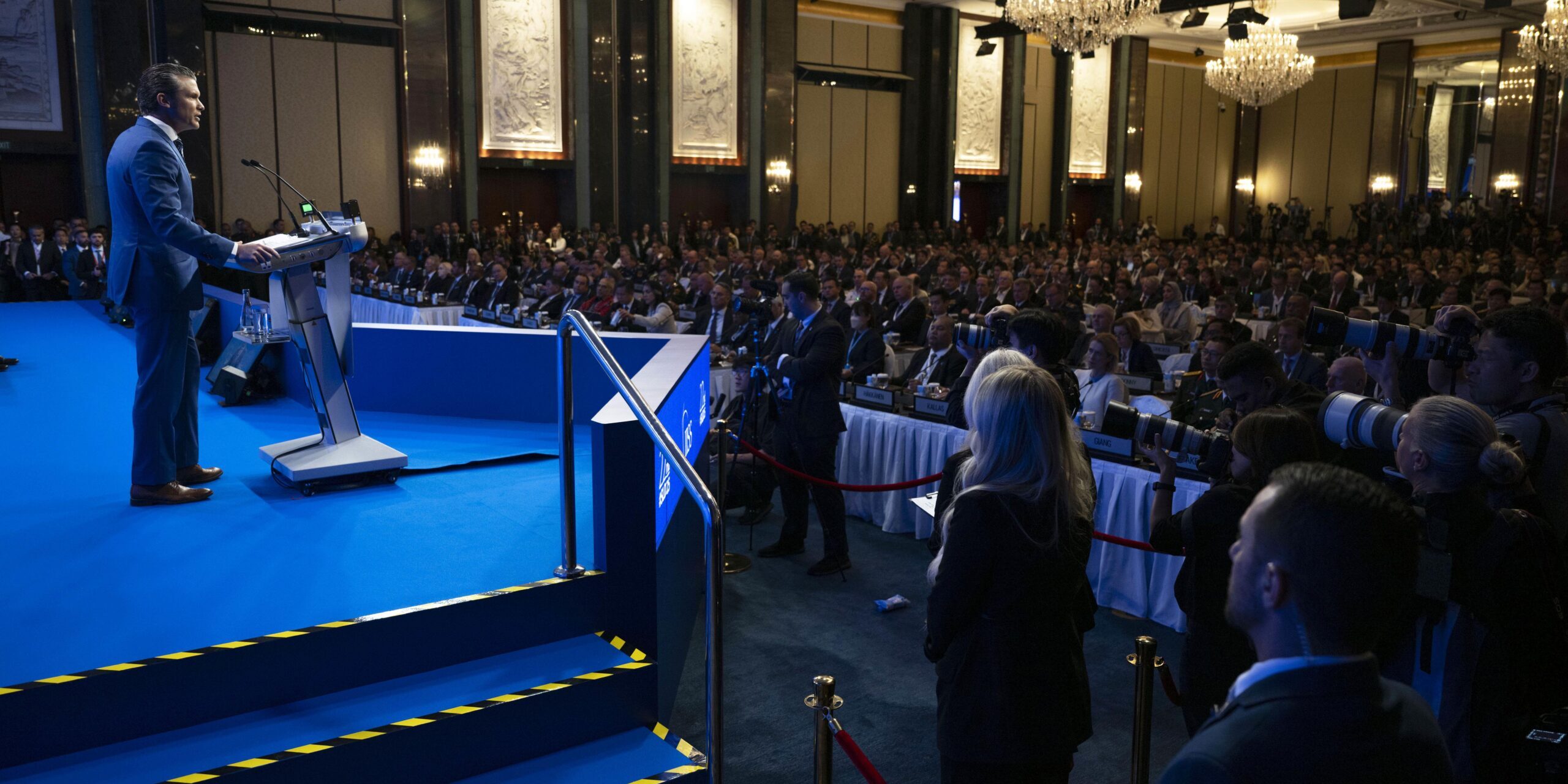
Pete Hegseth came to the 2026 Shangri-La Dialogue with a message that was, at minimum, honest. The U.S. Secretary of War told ministers from across the Indo-Pacific that alliances are not judged by the number of flags, but by the number of formations. Less Shangri-La. More ships. More submarines.
The reflex is to hear a threat, but it also works better as a sobering admission that the United States has stopped pretending that alliances run on goodwill and communiqués, and is demanding a renegotiation on transactional, capability-based terms. For regional governments in the Asia-Pacific, the question is now how the terms of stability will be priced, documented, and enforced.
Ironically enough, this position was created by the very disruptions that regional leaders have spent the last two years scrambling to absorb. Constant and recent rollbacks have not been subtle, what with USAID having been dissolved, Executive Order 14169 suspending foreign assistance wholesale and the administration withdrawing from sixty-six international organisations at once in January 2026 (the WHO and the Paris Agreement among them). When taken together, these are effectively dismantling the dependency architecture that the region’s non-security relationship with the US inherently rests upon.
The stability-via-hedging equilibrium assumes security from the United States, prosperity from China, and ASEAN in the middle, which also assumes that American commitment was a fixed feature of the landscape. In reality, these assumptions acted more as a loan, and Trump’s rollbacks have called the loan back in. These rollbacks have dissolved the terms that came with the dependency architecture. For one of the few times since the hub-and-spokes system was built, the price of partnership and its vocabulary anchor is now unsettled, and in its place, a clean slate as an accidental consequence of demolition remains. This is a genuine opening for the region to renegotiate market access alongside basing access, development alongside deterrence, and to do so as co-authors. The choice should not rest on whether to restore the arrangements of old nor whether to reject the United States outright. It should be predicated on whether each regional state can codify thresholds and trade-offs in advance before sitting across from the US.
Hedging was a practical strategy for postponing hard choices. So long as the United States functioned as a reliable backstop, governments could keep procurement, development, and diplomatic options open without specifying the triggers that would close them. With this now uncertain, hedging’s convenience becomes a liability whereby states must build the institutional muscles to define cross‑domain thresholds in advance instead of improvising under crisis pressure.
The obvious objection is that parts of the region already do this. Vietnam has published its “no’s” in defence white papers since 1998, expanding them to four in 2019, while Indonesia has run bebas dan aktif since Hatta articulated it in 1948, and Singapore’s ministers having named their red lines from podiums practically every other month. In short, the region is not lacking in general doctrine, but in doctrine built for a partner who gives in one domain while taking in another. The example of the Four No’s is a security answer for a security world, with nothing about when the US reaffirms a defence treaty while simultaneously gutting a development programme, as was the case for the Philippines in 2025.
None of this is to say the sky is falling or the window is slamming shut. At the 2025 Shangri-La, Hegseth asked allies to raise defence spending to 5 per cent of GDP and came back in 2026 asking for 3.5 per cent. This movement is the United States renovating the terms of partnership sternly, yes, but deliberately within reach and without outright evicting its partners. The language of this renovation reveals how old terms have lapsed, the new ones are still in draft, and the drafting is still at a stage where the region may have a hand in shaping.
The terms for drafting are not the only conditions. Looking at the vocabulary of older, established relationships, the language was unmistakably American, from “Free and Open Indo-Pacific” to the “rules-based order”; even ASEAN centrality has been framed as a principle that the great powers could endorse or withhold. To co-author the terms of the next phase is also to co-author its language, and to stop accepting a grammar of engagement the region does not wholly agree on.
Take four countries at different ends of the dependence spectrum and notice that none of them comes to the table empty-handed. Japan needs the credibility of the extended deterrent and the Seventh Fleet’s forward presence, as without them, its counterstrike buildup stops complementing American deterrence and starts triggering an arms race it cannot win alone. However, Japan is not a supplicant in this exchange, as it still hosts a continuously forward-deployed carrier strike group, while its shipyards have been filling in for gaps in America’s own industrial base, such as with Mitsubishi’s Yokohama yard having completed a full overhaul of a US Navy vessel in 2025 while American yards sat roughly 4,000 days behind on repairs.
South Korea makes the same point from a different angle. Seoul raised defence spending to 3.5 per cent, then converted the payment into authorship by pressing for wartime operational control transfer and opening the conversation on nuclear-powered submarines, both of which the US has publicly entertained.
For Indonesia, the Strait of Malacca carried some 29 per cent of all maritime oil flows and produced 59 per cent of the world’s nickel in 2024. What Indonesia would require is for the US to work through ASEAN-centred frameworks as opposed to being subject to bilateral pressure, preserving its ability to engage both great powers without being conscripted by either. The Philippines is the most exposed of the three and also the one holding nine EDCA sites, three of them in northern Luzon facing Taiwan. Yet, that this may be exactly what a one-domain relationship looks like, with ironclad treaty language and record Balikatan headcounts in the same year that EO 14169 gutted the development architecture giving the alliance its political legitimacy at home.
The lowest common denominator across all of them is that each state is defending the conditions under which it can keep making its own decisions across security, economic, and development domains at once. Until recently, every one of these domains had that floor underwritten by an American reliability that is now less certain. Now, both tightly integrated allies and more distant partners face comparable strategic pressures and must reassess priorities or risk being pushed into difficult choices with less autonomy.
To be precise, nothing binds a superpower like the US that can walk out of the TPP, the Paris Agreement, the JCPOA, and sixty-six international organisations inside a decade. The floor that the Asia-Pacific region holds is an internal discipline that lives in defence white papers that link domains domestically, procurement schedules with diversification triggers already written in (decided in advance rather than debated mid-crisis), negotiation briefs that price the whole relationship rather than the defence line alone, and in documents durable enough to survive each state’s own election cycles beyond just America’s.
If “model allies” merit expedited arms sales and deep co‑production, the converse of partners being able to demand continuity in development, market access, and integrated economic commitments should hold. Practically, that means negotiating cross‑domain annexes to security agreements, embedding procurement diversification triggers in defence plans, and creating ASEAN‑anchored contingency mechanisms that preserve development programs through political shocks. Simply put, if 2 per cent is freeloading, then the region is entitled to insist right back, and to refuse having to pay full freight for half a relationship.
The Strait of Hormuz was a scenario that was flagged, discussed and anticipated long before war broke out between the US and Iran, especially with 84 per cent of Hormuz crude flowing to Asian markets, but many countries still scrambled when the crisis arrived, giving more than they had to protect their own energy sources and receiving less than they should. All this to say that anticipation is not preparation unless the position was built in advance; otherwise, the region is just watching the same crisis arrive without a plan.
As terms harden into institutions, and those institutions tilt toward whoever showed up with their conditions already written, the only question that will matter in the end is whether the Asia-Pacific had a hand in authoring those terms or only receiving them.
Author: Wira Gregory is a Brunei-based analyst covering Southeast Asian diplomatic, geopolitical, and security developments