Photo: The STAR, John Unson
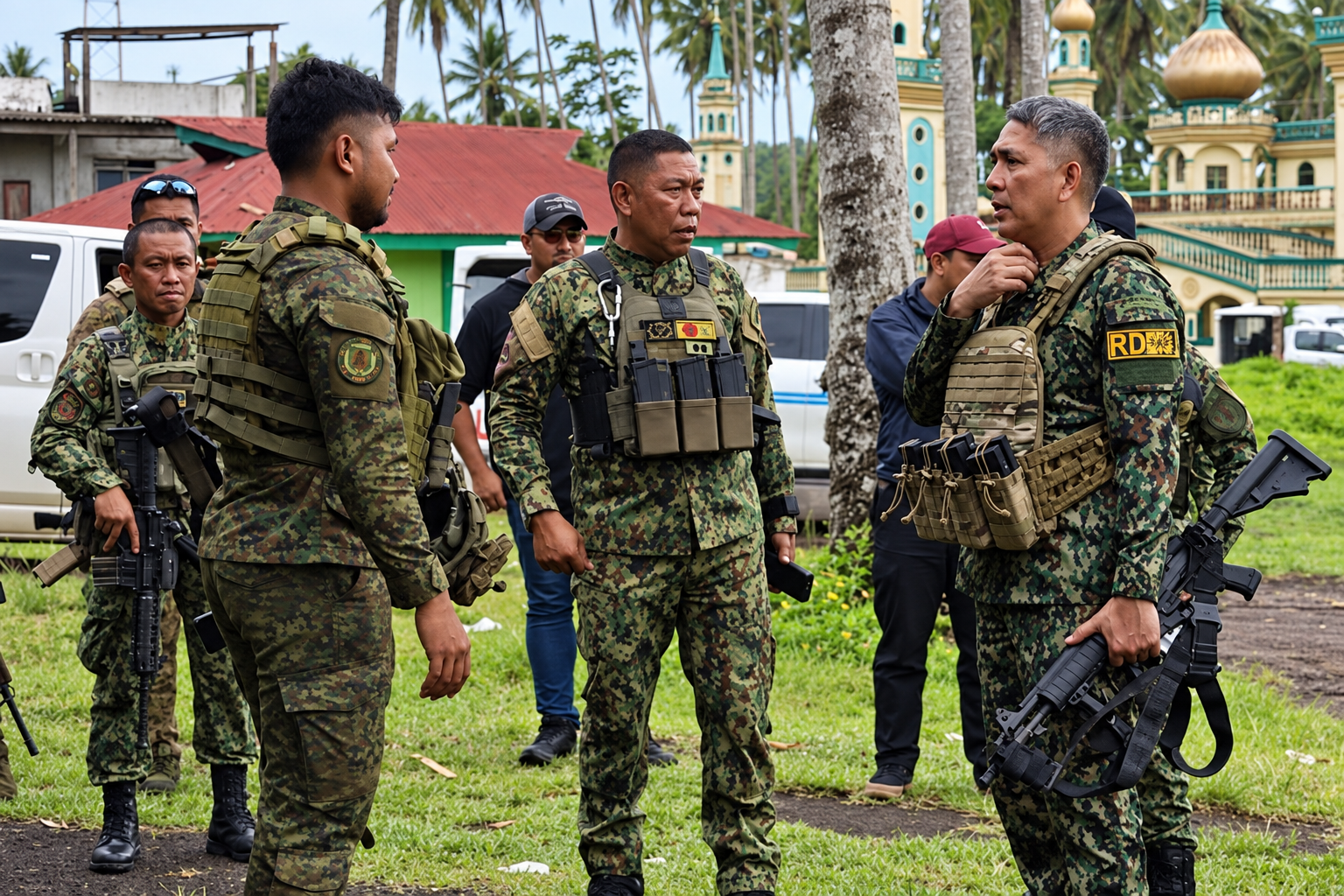
Suspected leader of the Dawlah Islamiyah (DI)-Hassan Group, Yusa Ganoy, along with three of his followers, was killed during a counterterrorism operation in Barangay Tapayan, Sultan Mastura, Maguindanao del Norte, Philippines, on 16 October 2026. The operation was conducted by a joint force composed of the Philippine National Police (PNP) Criminal Investigation and Detection Group (CIDG), the Philippine Navy’s 1st Marine Brigade and 2nd Marine Battalion, the Bangsamoro Police and other security units.
The operation was launched to serve multiple arrest warrants against Ganoy (alias “Minimi”). However, it escalated into an armed clash when Ganoy and his companions allegedly opened fire on the arresting team. The ensuing firefight lasted for approximately five minutes and resulted in the deaths of the four suspected terrorists. Meanwhile, there were no officially confirmed casualties among government security forces.
Authorities recovered one assault rifle, three .45-calibre pistols, an improvised explosive device (IED) and other firearms from the scene.
Yusa Ganoy was the fourth most wanted person in Maguindanao del Sur and was also listed as Priority Sanction Target No. 11 by authorities. He was linked to bomb attacks in Isulan, Sultan Kudarat, an area that experienced a series of improvised explosive device (IED) attacks. These included the 28 August 2018 IED explosion, which resulted in significant casualties after an explosive device detonated along the National Highway in Barangay Kalawag III during festival celebrations, and another IED explosion on 2 September 2018, which also caused casualties inside an internet café in Isulan. On 17 April 2023, another IED exploded at a bus terminal in Isulan, although the perpetrator of the 2023 bus terminal bombing was later arrested in August 2026.
It should be noted, however, that the series of IED attacks in 2018 has not been conclusively linked to Yusa Ganoy. Some fairly reliable local sources have repeatedly mentioned Ganoy and the DI-Hassan Group’s alleged involvement in these terrorist attacks and related harassment activities. Nevertheless, these incidents remain relevant because Ganoy and his group reportedly possessed knowledge and expertise in the use of improvised explosive devices (IEDs). In fact, an IED was recovered by security forces at the scene of the operation that resulted in his death.
Dawlah Islamiyah has historically used IEDs as a primary tactical weapon. In practice, these groups are severely outgunned by Philippine security forces, making IEDs an effective force multiplier that allows them to inflict damage without engaging in prolonged direct confrontations, which they are generally incapable of sustaining.
Ganoy was also facing multiple criminal charges, including multiple counts of murder, frustrated murder, arson, direct assault, drug trafficking, extortion and violations of the Anti-Terrorism Act of 2020.
Dawlah Islamiyah in Mindanao, Philippines
Counterterrorism experts, researchers and security authorities have identified several Dawlah Islamiyah (DI) factions, including the DI-Hassan Group, DI-Turaifie Group and DI-Karialan Group, among many others. These factions differ in their leadership, areas of operation and organisational capabilities. In general, Dawlah Islamiyah is not a single, unified terrorist organisation but rather a loose network of pro-Islamic State militant groups operating in Mindanao.
The DI-Hassan Group operates primarily in the Maguindanao area. However, Dawlah Islamiyah has become significantly weaker than it was during the period surrounding the Marawi Siege in 2017. This decline can be attributed to sustained counterterrorism operations, the neutralisation of key leaders, arrests and the surrender of members. Despite these setbacks, Dawlah Islamiyah remains an active security threat and continues to be monitored by Philippine security forces due to its capability to conduct localised attacks and other violent activities.
Following the death of the suspected leader, Yusa Ganoy, the Philippine National Police (PNP) heightened security measures across parts of the Bangsamoro Autonomous Region in Muslim Mindanao (BARMM). The move is intended to suppress potential retaliatory attacks by the group’s remaining members. This concern is not new, as there is historical precedent for possible retaliation by Dawlah Islamiyah. For example, the December 2023 Mindanao State University (MSU) Marawi bombing was assessed by the PNP as a possible response to sustained military pressure against Dawlah Islamiyah cells in Lanao del Sur.
While the death of Yusa Ganoy represents a tactical victory for local security forces, the reality is that Dawlah Islamiyah has not yet been fully dismantled. The loss of leaders has proven to be a sign of weakness, but the group’s operations may continue as its factions and local cells remain active. Terrorism in the Philippines has weakened over time due to effective intelligence-driven counterterrorism operations and strong cooperation among local authorities and security forces. However, conventional armed confrontation is not the primary strategy of these terrorist groups. Instead, they rely on asymmetric tactics that are low-cost but high-impact.
Ganoy’s Death and Social Media Sympathizers
A video that resurfaced on Facebook and was shared by locals in Maguindanao del Sur and Maguindanao del Norte showed Ganoy sitting in a hammock while preaching about his unwillingness to surrender to authorities. In the video, he reportedly claimed that those who surrender would go to hell.
Additionally, a Facebook post from an anonymous account appeared to attract numerous sympathisers of the slain terrorist. The post expressed regret over Ganoy’s death and seemingly urged him to surrender in order to avoid danger. It also referenced the continued division among various groups, although it did not explicitly identify them as Dawlah Islamiyah factions. According to the post, internal conflicts and fragmentation among these groups have made it easier for security forces to conduct operations against them. The post was published on Facebook on 17 October, one day after Ganoy’s death.
Some online expressions of mourning following Ganoy’s death raise several important points of contention. These reactions may indicate the persistence of ideological support for the deceased militant and contribute to narratives portraying him as a symbol of resistance or martyrdom. They may also reinforce group identity or, under certain circumstances, serve as a gateway for propaganda and recruitment.
However, the available observations of the author do not independently establish the extent of ideological support or demonstrate that these expressions translate into active mobilisation. The emergence of explicit calls for retaliation or other forms of violent action would warrant closer scrutiny as potential indicators of a heightened threat.
The reality is that while authorities view Ganoy as a criminal, some individuals may perceive him as a freedom fighter or as someone who represents their grievances, identity or aspirations. However, such perceptions should not be generalised to the wider local population, whose views and experiences are diverse. This divergence in perception is significant, as it highlights how the legitimacy of an armed actor can be interpreted differently by state authorities and certain segments of society. Understanding this divide is essential to examining not only the persistence of militant sympathies but also the broader political, social and historical conditions that shape them.
With the recent success of the Bangsamoro Parliamentary Elections, civic education and counterterrorism operations must remain integral to efforts to achieve sustainable peace in a region historically affected by armed conflict and militancy. These initiatives constitute essential components of long-term peace and stability in BARMM and across Mindanao.
However, electoral success does not necessarily eliminate competing sources of legitimacy. Figures like Ganoy may be perceived by some individuals as legitimate representatives of their grievances, identities or aspirations. This highlights the need to complement security operations with inclusive governance, civic education and sustained community engagement to strengthen public trust in democratic institutions and address the conditions that allow militant narratives to persist.
Sources:
1. Unson, J. and Pareño, R., ‘4 “terrorists” killed in Mindanao shootout’, The Philippine Star, 18 October 2026.
2. ‘Dawlah Islamiyah commander, 3 others slain in Maguindanao del Norte clash – military’, Manila Bulletin, 17 October 2026.
3. ‘PNP alerts units in BARMM after death of Dawlah Islamiyah sub-leader in Maguindanao operation’, Manila Bulletin, 18 October 2026.
4. Yeo Yaoren, K., Decapitation, Retaliation, and the Indicators of Escalation in Mindanao, Policy Brief, International Centre for Counter-Terrorism (ICCT), 15 November 2023.
Kristian Rivera is a Master’s Candidate in Peace Studies, majoring in Conflict Analysis, at Silliman University. He is a Political Science Lecturer at Southern Mindanao Colleges. He is an alumnus of the Young Southeast Asian Leaders Initiative (YSEALI) Academic Fellowship and completed the program at the University of Nebraska Omaha under the Civic Engagement theme in 2024.