Photo: source undetermined, various.
Incident Date: 11 August 2026
The initial assessment of the M/V TIHAMAH (IMO 1031329) incident as a fire/blast casualty must now be revised. Current reporting attributes the incident to a Houthi missile attack in the Bab el-Mandeb, with the subsequent targeting of rescue personnel significantly increasing the security implications of the event. Multiple maritime-security and international shipping sources report six fatalities, comprising four seafarers and two Yemeni personnel involved in the rescue response.
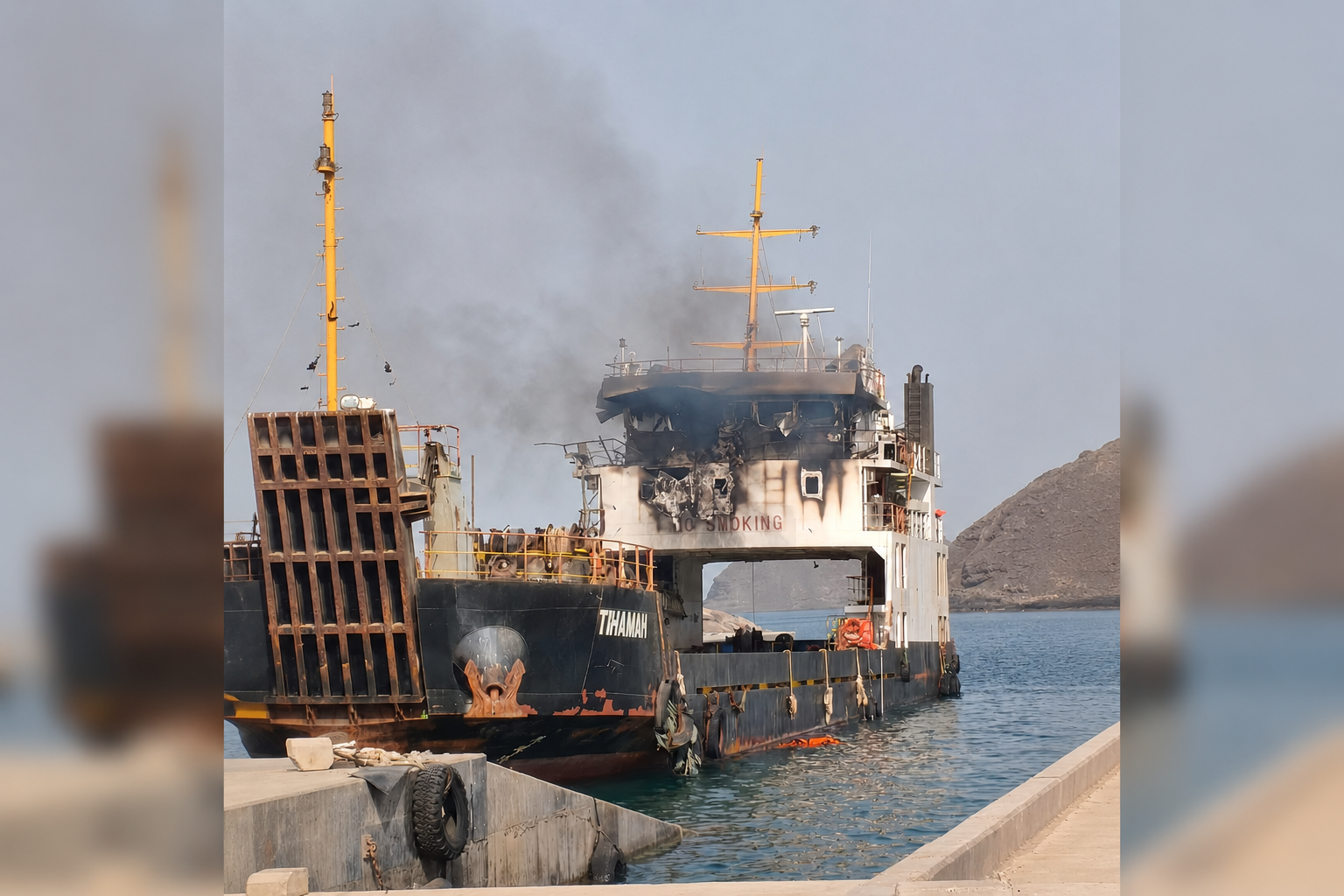
On 11 August 2026, the Tanzania-flagged M/V TIHAMAH, a commercial deck-cargo/general-cargo vessel, was attacked while operating in the strategically critical Bab el-Mandeb area, near Perim Island.
The initial attack caused severe fire and structural damage, particularly to the bridge and superstructure, compromising critical command, navigation and communications functions.
The incident subsequently escalated when a second strike was reportedly conducted while rescue operations were underway, resulting in the deaths of two Yemeni rescuers. This element is particularly significant from a maritime-security perspective because it indicates that the threat extended beyond the vessel itself to personnel attempting to conduct a humanitarian/SAR response.
Current reporting indicates:
- 6 fatalities
- 4 commercial seafarers
- 2 Yemeni rescue/security personnel
- Approximately 10 injured
- Multiple crew and responding security personnel required medical treatment.
- The vessel sustained severe localized damage but remained afloat.
This casualty picture supersedes the earlier preliminary assessment based solely on vessel imagery.
Attack Methodology
The reported attack demonstrates a multi-stage kinetic engagement rather than a conventional single-impact maritime incident.
Phase 1 — Initial Missile Strike: The vessel was struck by multiple missiles, producing fire and severe damage around the bridge/superstructure.
Phase 2 — Emergency Response: Crew and Yemeni security/rescue personnel initiated emergency response and casualty evacuation.
Phase 3 — Secondary Strike / “Double-Tap”: A subsequent attack reportedly targeted the vessel/rescue area while emergency operations were underway, killing two Yemeni rescuers.
From a security-observer perspective, this second phase is the most strategically significant component of the incident.
Security Assessment
The TIHAMAH incident demonstrates a potentially deliberate denial-of-rescue effect: once a merchant vessel has been disabled, the threat may continue against personnel attempting to approach, evacuate or secure the casualty.
This creates a substantially more complex operating environment for:
- Commercial shipping
- Naval escorts
- Coast Guard units
- Search-and-rescue teams
- Salvage vessels
- Medical evacuation assets
- Port and maritime-security authorities
It also creates a difficult operational dilemma: approaching a disabled vessel may itself expose rescuers to secondary attack.
Strategic Significance
The incident is important beyond the individual vessel because the Bab el-Mandeb is a strategic maritime chokepoint linking the Red Sea with the Gulf of Aden and the wider Indian Ocean shipping system.
The attack therefore reinforces the assessment that the southern Red Sea cannot be treated simply as a commercial navigation corridor. It must be considered a contested maritime-security environment where kinetic threats, intelligence indicators, vessel profiling and emergency-response risks overlap.
The IMO has subsequently urged shipping interests to undertake careful risk assessments concerning Red Sea voyages following the fatal attack.
Attribution and Targeting
The attack has been attributed by Yemeni authorities and multiple maritime-security reports to Iran-aligned Houthi forces. Reuters likewise reported that four crew members and two Yemeni rescuers were killed in a suspected Houthi attack on an Egyptian-linked ship in the Bab el-Mandeb.
The Houthis reportedly claimed the vessel was connected to Saudi military logistics. However, available reporting has raised questions concerning the vessel’s actual commercial ownership/management and cargo profile.
Therefore, the claimed targeting rationale should be treated separately from the confirmed physical attack. A group’s justification for targeting a commercial vessel does not independently establish that the vessel constituted a legitimate military target.
Threat Level: CRITICAL — COMMERCIAL MARITIME SHIPPING
The M/V TIHAMAH attack represents a significant escalation in the threat environment because it combines:
MISSILE ATTACK → VESSEL FIRE/DAMAGE → CREW CASUALTIES → SAR RESPONSE → SECONDARY ATTACK → RESCUER FATALITIES.
The operational lesson is clear: the threat does not necessarily terminate when the initial missile strike ends.
For maritime operators, the incident demonstrates that a disabled vessel in the Bab el-Mandeb may become a secondary-target environment, with rescue and recovery operations potentially exposed to additional kinetic attacks.
M/V TIHAMAH should therefore be classified not merely as a commercial vessel casualty, but as a major maritime-security incident with strategic implications for the Bab el-Mandeb, Red Sea and Gulf of Aden corridors.
The principal concern is no longer whether the damage was accidental or intentional. Current reporting establishes an intentional kinetic attack attributed to Houthi forces. The key intelligence question now becomes whether the TIHAMAH incident represents an isolated engagement or part of a broader operational pattern designed to make the southern Red Sea commercially and operationally untenable.
For shipowners, masters, naval forces and SAR authorities, the critical lesson is:
In a contested maritime corridor, the rescue operation itself may become part of the threat envelope.
This incident should consequently trigger an immediate reassessment of voyage risk, routing, vessel identification, AIS exposure, emergency-response procedures, naval coordination and SAR protocols for commercial traffic approaching the Bab el-Mandeb.
Author: Mauritius-based Bruneau Laurette is Director of DRCS Africa HQ and an elite defence and security consultant with over 25 years of experience in high-risk environments, maritime anti-piracy and port security. He has advised the governments of Mauritius, Seychelles and Tanzania, established specialist tactical units and trained law enforcement and correctional officers.