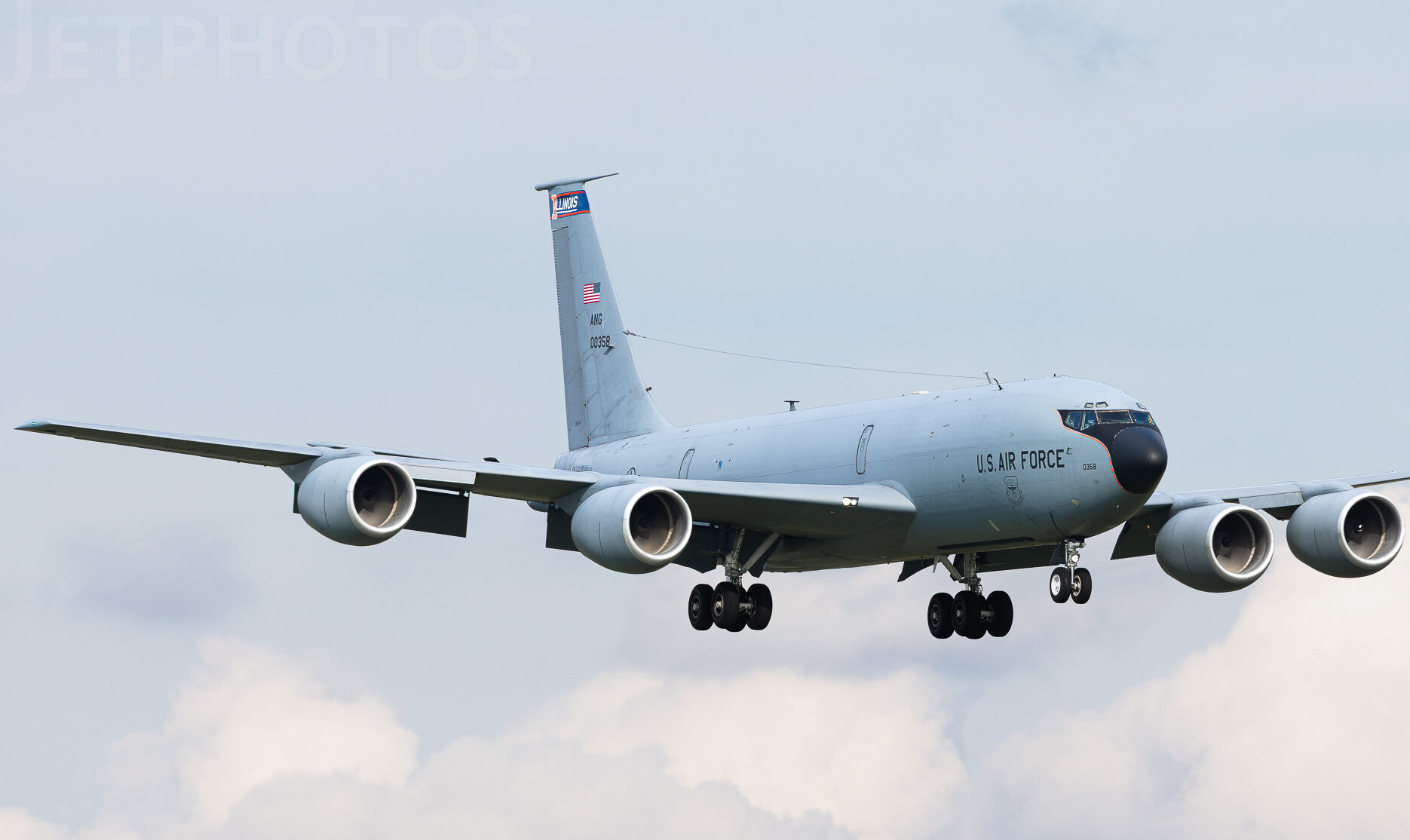
Photo: EdwinS, Flightradar24
Iran and the United States have suspended direct attacks since 29 July, but military activity across the Middle East has by no means stopped. Open-source tracking of US military aircraft between 10 and 16 August 2026 shows continued aerial refuelling, transport and intelligence activity across the region, suggesting that Washington is maintaining a significant operational posture despite the current pause in hostilities.
The data does not provide a definitive answer as to whether the United States is reinforcing, replenishing or gradually redistributing its forces. It does, however, offer several useful indicators when placed within the broader regional picture.
Aerial Refuelling Remains the Core of US Air Activity
Aerial refuelling aircraft accounted for approximately 60% of the trackable US military flights observed during the period. The majority involved KC-135 and KC-46 tanker aircraft operating from several key locations across the region.
Among the trackable flights, the principal operating locations were:
- Tel Aviv
- Eilat
- Al Kharj
- Al Udeid, although activity there was considerably lower
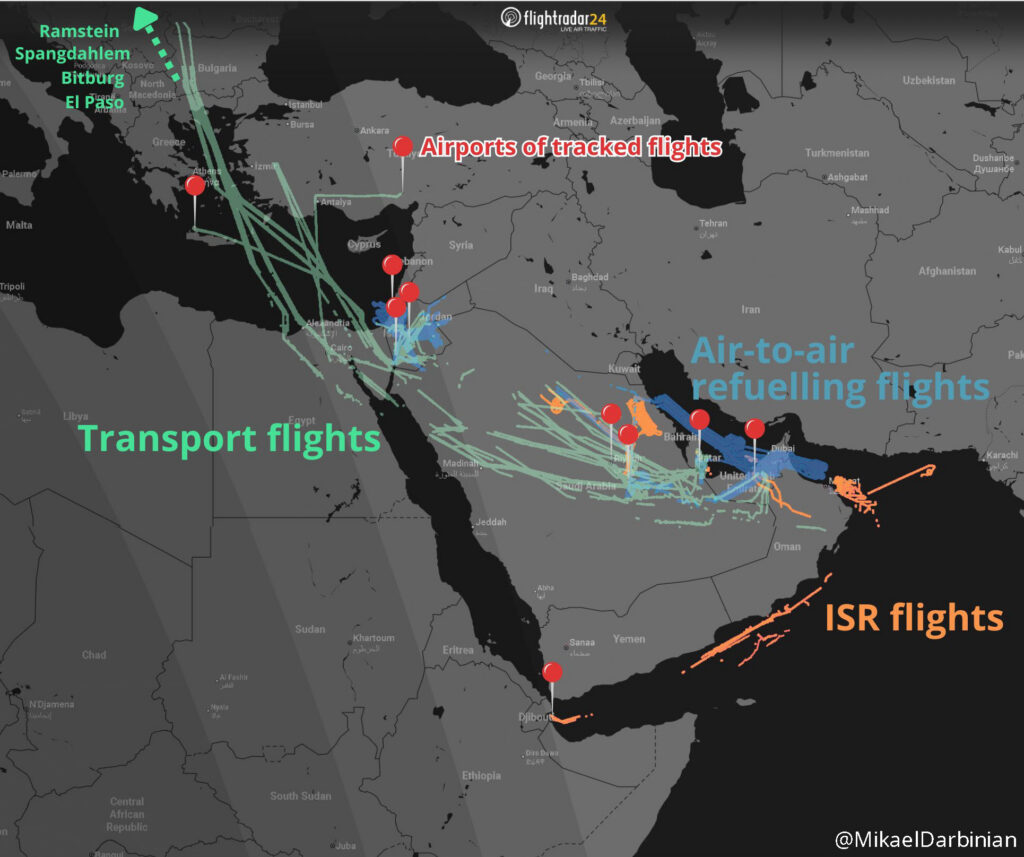
The limited activity from Al Udeid is particularly noteworthy. Trackable flights from the base had almost disappeared for more than a month, potentially reflecting the impact of earlier Iranian attacks against the installation and subsequent adjustments to US operating patterns.
Despite this, the wider tanker routes appear to have remained largely unchanged since the military campaign that began on 28 February. Many of the observed aircraft continued to conduct holding patterns to the east of the Strait of Hormuz and on both sides of the waterway, particularly over waters north-west of the United Arab Emirates and north-west of Muscat.
These patterns underline the importance of Saudi and Emirati airspace for US operations. Geography makes access to these corridors particularly important for sustaining air activity around the Gulf and the Strait of Hormuz.
Transport Flights Are the Most Noticeable Change
Transport aircraft accounted for approximately 25% of the flights observed. This category included platforms such as the C-17, C-5 and C-130.
Compared with the previous month, transport activity appeared noticeably higher. Most of the trackable transport flights originated in Europe, particularly from Ramstein and Spangdahlem, while additional movements were observed from Chania and Turkey. Individual flights were also seen originating from Bitburg and El Paso.
The main destinations included:
- Al Udeid
- Airfields in the United Arab Emirates
- Riyadh
- Al Kharj
- Israeli airfields
This increased level of airlift activity raises one of the most important questions emerging from the dataset: are US forces replenishing their regional bases, or is equipment being withdrawn and redistributed?
Open-source flight tracking alone cannot provide a clear answer. Strategic airlift can support several different objectives, including:
- routine resupply;
- personnel rotations;
- movement of spare parts and equipment;
- replenishment of stocks consumed during earlier operations;
- reinforcement of particular installations; or
- transfer of material away from the region.
The increase therefore deserves attention, but it should not automatically be interpreted as evidence of preparations for renewed conflict.
ISR Activity Remains Relatively Stable
Intelligence, surveillance and reconnaissance flights represented approximately 15% of the observed activity.
The most visible platforms were P-8 Poseidons and E-3 Sentries. Trackable P-8 flights operated almost exclusively from Djibouti and generally conducted missions off the coast of Oman, while E-3 aircraft operated mainly from Al Kharj and flew over north-eastern Saudi Arabia.
At least one P-8 was observed departing from Bahrain, although this appeared unusual within the wider pattern.
Overall, ISR activity has remained broadly consistent in terms of both frequency and operating areas. During the previous month, some flights may have operated slightly further north, particularly near the coast of Fujairah in the United Arab Emirates, but the difference appears relatively minor.
There is also an important limitation to keep in mind: this assessment covers only aircraft visible on publicly available tracking platforms. Military aircraft may disable transponders, operate under restricted tracking conditions or disappear entirely from open-source platforms. The absence of a flight from public data therefore does not necessarily mean that no mission took place.
What Has Changed Since the Ceasefire?
Taken as a whole, the available data points towards continuity rather than disengagement. US military aircraft remain active across the region despite the suspension of direct attacks between Washington and Tehran.
The main trends observed during the period were:
- Aerial refuelling remained substantial, after having briefly declined following the 8 June ceasefire.
- ISR activity continued with relatively little change in both frequency and operating areas.
- Transport activity appeared higher than during the previous month, making it the most noticeable change in the dataset.
- Al Udeid remained relatively quiet in terms of trackable departures, compared with other regional bases.
The most significant analytical question is therefore not whether US military activity continues, but what the increased transport movements actually represent. Reinforcement, replenishment, rotation and withdrawal are all possible explanations, and the available flight data does not allow any of them to be confirmed with confidence.
Flight Tracking Is Only One Piece of the Puzzle
Aircraft movements are only one part of the broader intelligence picture. Military aviation data must be compared with other indicators before drawing conclusions about strategic intent.
A more complete assessment should also examine:
- official statements from the United States, Iran and regional governments;
- movements of naval vessels and commercial shipping;
- unusual activity at military and commercial ports;
- visits by senior political and military officials;
- meetings between regional leaders;
- changes in military deployments and logistics flows;
- traffic through strategic waterways, where data is available; and
- broader trade and commercial flows, although these are often harder to monitor in the short term.
No single indicator is sufficient. An increase in transport flights, taken in isolation, may represent routine logistics. The same increase would become far more significant if it occurred alongside intensified tanker activity, higher ISR activity, naval repositioning, emergency diplomatic meetings and visible changes in force posture.
The value of OSINT therefore lies less in finding one decisive piece of information than in correlating multiple independent indicators.
Operational Activity Can Precede Political Developments
Much public discussion of the Middle East focuses primarily on the geopolitical level: negotiations, alliances, political statements and relations between states. That provides an essential framework, but it can also create an overly broad picture.
Operational developments on the ground can sometimes move ahead of political messaging. Changes in military logistics, reconnaissance patterns, naval movements or force posture may appear before governments publicly explain their intentions. In some cases, these indicators can provide early clues about developments that are not yet reflected in diplomatic statements.
The reverse is also true. Military movements can easily be misinterpreted when removed from their political and strategic context.
A more complete assessment therefore requires both perspectives: geopolitical analysis helps explain why states may act, while operational and open-source intelligence can help assess what they may actually be doing.
Conclusion
US military air activity in the Middle East remains significant despite the current pause in direct attacks between Iran and the United States. Between 10 and 16 August, aerial refuelling continued to account for the majority of trackable flights, while ISR activity remained broadly stable. Transport activity, however, appeared higher than during the previous month and represents the most notable development in the available data.
At this stage, the main conclusions are:
- US military aviation activity in the region has not significantly wound down.
- Aerial refuelling remains a major component of the US regional air posture.
- ISR patterns appear broadly stable.
- Transport activity has increased and deserves closer monitoring.
- The purpose of those transport movements cannot yet be determined from flight tracking alone.
Flight tracking should therefore not be viewed as an answer in itself. It is one piece of a much larger puzzle, and the clearest picture will emerge only by combining military aviation data with maritime movements, political meetings, logistics activity, official statements and other observable indicators across the region.
Author: Mikael Darbinian is a former US diplomat, geopolitical and military analyst and founder of Security Observer. He specialises in foreign policy analysis, military affairs and international security.