Photo: Saudi Press Agency
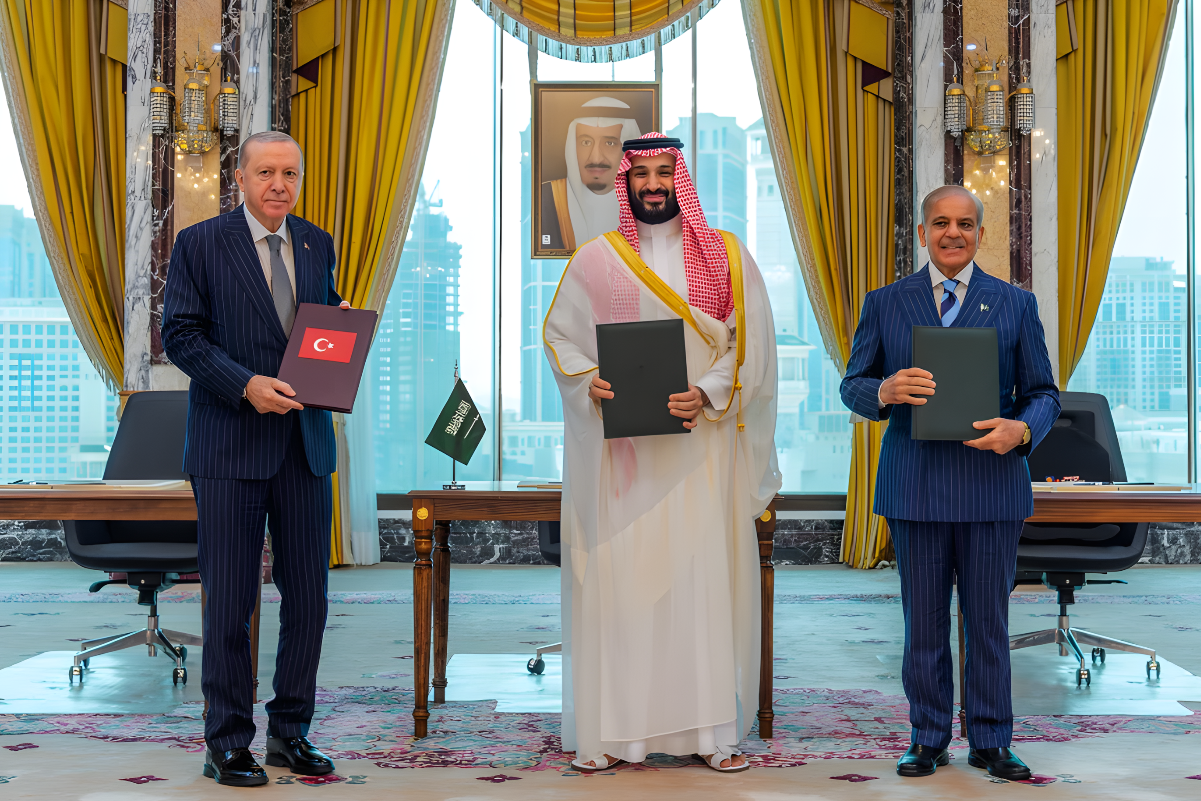
Turkey, Saudi Arabia and Pakistan signed a new joint defence agreement in Mecca on 7 August 2026, marking a significant expansion of security cooperation between three major Sunni Muslim powers. The full text of the agreement has not been made public, meaning its precise legal obligations, implementation mechanisms and military provisions remain unclear. However, reporting on Saudi officials indicates that the agreement includes a collective-defence principle similar to NATO’s Article 5, under which an armed attack against one participant could be regarded as an attack against all.
Two broad scenarios could explain the strategic logic behind the pact:
- US-supported containment of Iran: Washington may view stronger cooperation between Turkey, Saudi Arabia and Pakistan as a way of reinforcing a regional security architecture around Iran while distributing responsibility for deterrence among key regional partners. This remains an interpretation rather than an officially stated purpose, and Turkish officials have publicly rejected suggestions that the agreement is directed specifically against Iran.
- Greater strategic autonomy: the three countries may instead be responding to perceived weaknesses or uncertainty surrounding US security guarantees in the region, creating a mechanism through which regional powers can provide greater security for themselves. Iran itself has publicly interpreted the agreement in terms of increasing regional self-reliance rather than dependence on external powers.
The agreement could therefore represent either an extension of the existing US-centred regional security architecture or an attempt to build something increasingly independent of it. Egypt is also a plausible future participant: Cairo already participates with Turkey, Pakistan and Saudi Arabia in a four-country consultative framework focused on regional security and stability, although this should not yet be interpreted as confirmation that Egypt will join the Mecca defence pact. If the agreement eventually develops into joint defence planning, intelligence sharing, exercises or operational military coordination, it could significantly alter the security balance across the Middle East and South Asia and potentially become the foundation of a broader regional military bloc.
Author: Mikael Darbinian is a former US diplomat, geopolitical and security analyst and founder of Security Observer. He specialises in foreign policy analysis, military affairs and international security.