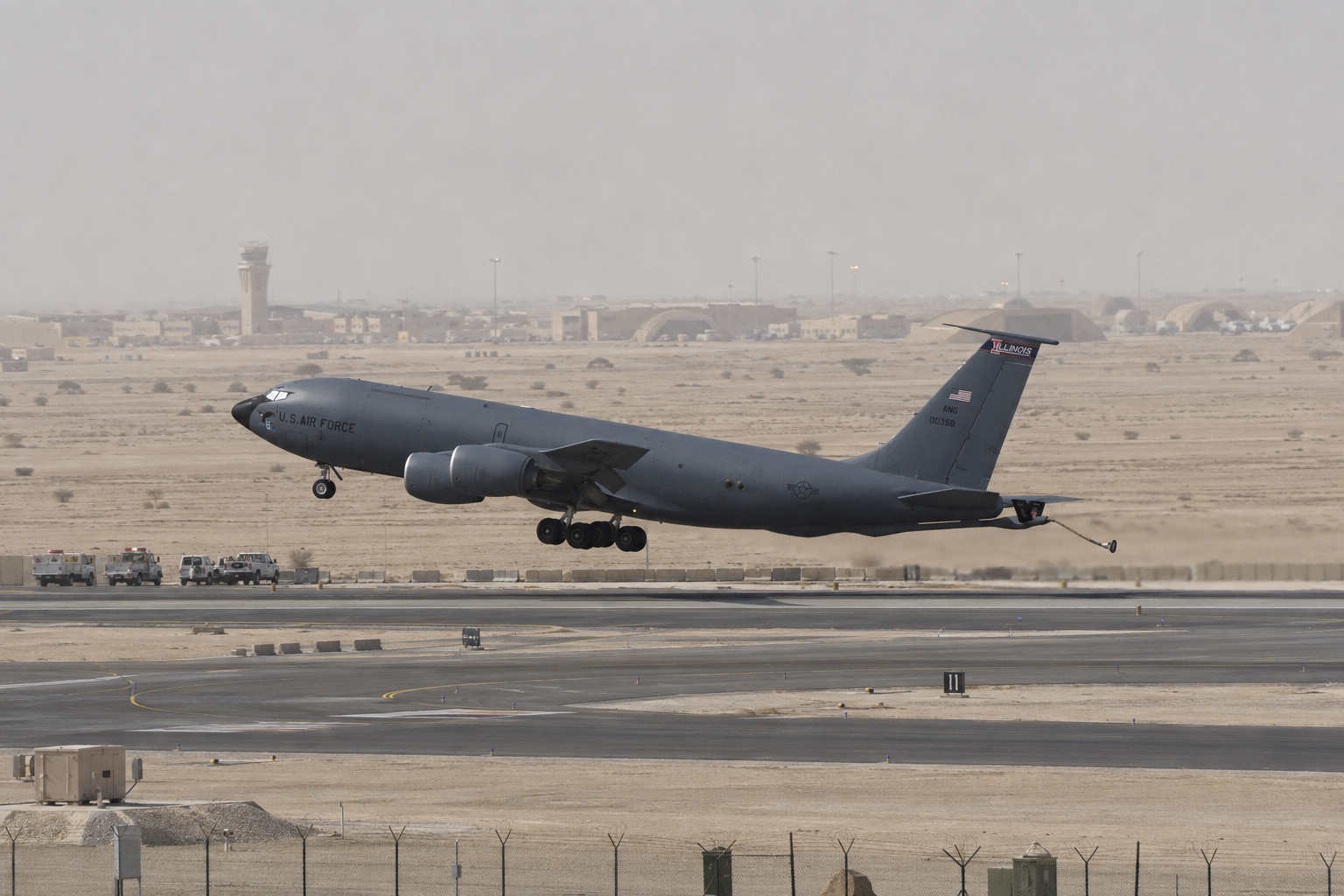
Satellite imagery and open-source flight-tracking data indicate that the United States has withdrawn the KC-135 and KC-46 aerial refuelling aircraft previously operating from Al Udeid Air Base in Qatar. Recent imagery reportedly shows the parking areas used by these aircraft largely empty, although other American transport and support aircraft remain at the installation.
Al Udeid is Qatar’s largest military air base and one of the principal centres for US operations in the Middle East. It has hosted thousands of American personnel and provides command, logistics, intelligence and air support capabilities for operations across the region.
Most publicly observable US aerial refuelling activity now appears to originate from Israel and Al Kharj in Saudi Arabia. Open-source observers estimate that these locations account for close to 90 per cent of recently tracked missions, although this figure cannot be independently confirmed because military aircraft frequently limit or disable publicly visible tracking.
The relocation may represent a temporary operational success for Iran if the threat of Iranian missile attacks compelled Washington to remove vulnerable aircraft from Qatar. However, it does not constitute a complete American withdrawal from Al Udeid. Dispersing aircraft between several bases also reduces the risk of losing a large part of the refuelling fleet in a single attack.
The pause in direct hostilities has meanwhile ended. Iran launched ballistic missiles towards US military positions in Jordan on 28–29 July, reportedly targeting Muwaffaq Salti Air Base. Jordan said that five missiles were intercepted before reaching their targets and no significant damage was immediately confirmed.
US and Saudi aircraft subsequently carried out coordinated strikes against Iran-aligned armed groups and weapons facilities in eastern Iraq. US Central Command said the strikes followed more than 30 attempted drone attacks against American forces and Saudi infrastructure. The renewed exchanges have weakened hopes that negotiations mediated by Oman and other regional states could quickly produce a lasting ceasefire.
Key developments:
- US KC-135 and KC-46 aerial refuelling aircraft are no longer visibly operating from Al Udeid
- Satellite imagery shows their former parking areas largely empty
- Most observable refuelling missions now appear to originate from Israel or Al Kharj
- Iran may have temporarily reduced Washington’s use of Al Udeid through military pressure
- Iran targeted US military positions in Jordan with ballistic missiles
- US and Saudi forces struck Iran-aligned armed groups in Iraq
- The latest attacks ended the brief pause in direct regional hostilities
The conflict’s longer-term direction may also be influenced by Israeli domestic politics. Prime Minister Benjamin Netanyahu continues to favour sustained pressure on Iran, while any political change in Israel could alter the prospects for de-escalation. For now, the movement of US aircraft and the renewed attacks in Jordan and Iraq indicate that Washington is reorganising its regional posture rather than reducing its military involvement.
Author: Mikael Darbinian is a former US diplomat, geopolitical and security analyst and founder of Security Observer. He specialises in foreign policy analysis, military affairs and international security.