Photo: Francisco Seco/Pool via Reuters
Five years after President Kais Saïed dismantled Tunisia’s parliamentary system and concentrated executive power, the country is no longer merely drifting toward instability. It is accelerating into a full-blown multidimensional crisis that threatens to rupture the central Mediterranean’s fragile equilibrium. For Brussels, Rome, and Paris, the equation is stark: the cost of allowing Tunisia to unravel will far exceed the price of a genuine rescue strategy. Yet Europe continues to misdiagnose the ailment, treating Tunisia as a border-control file rather than as a geopolitical anchor whose loss would send shockwaves directly into the Schengen area.
A Transactional Model at a Dead End
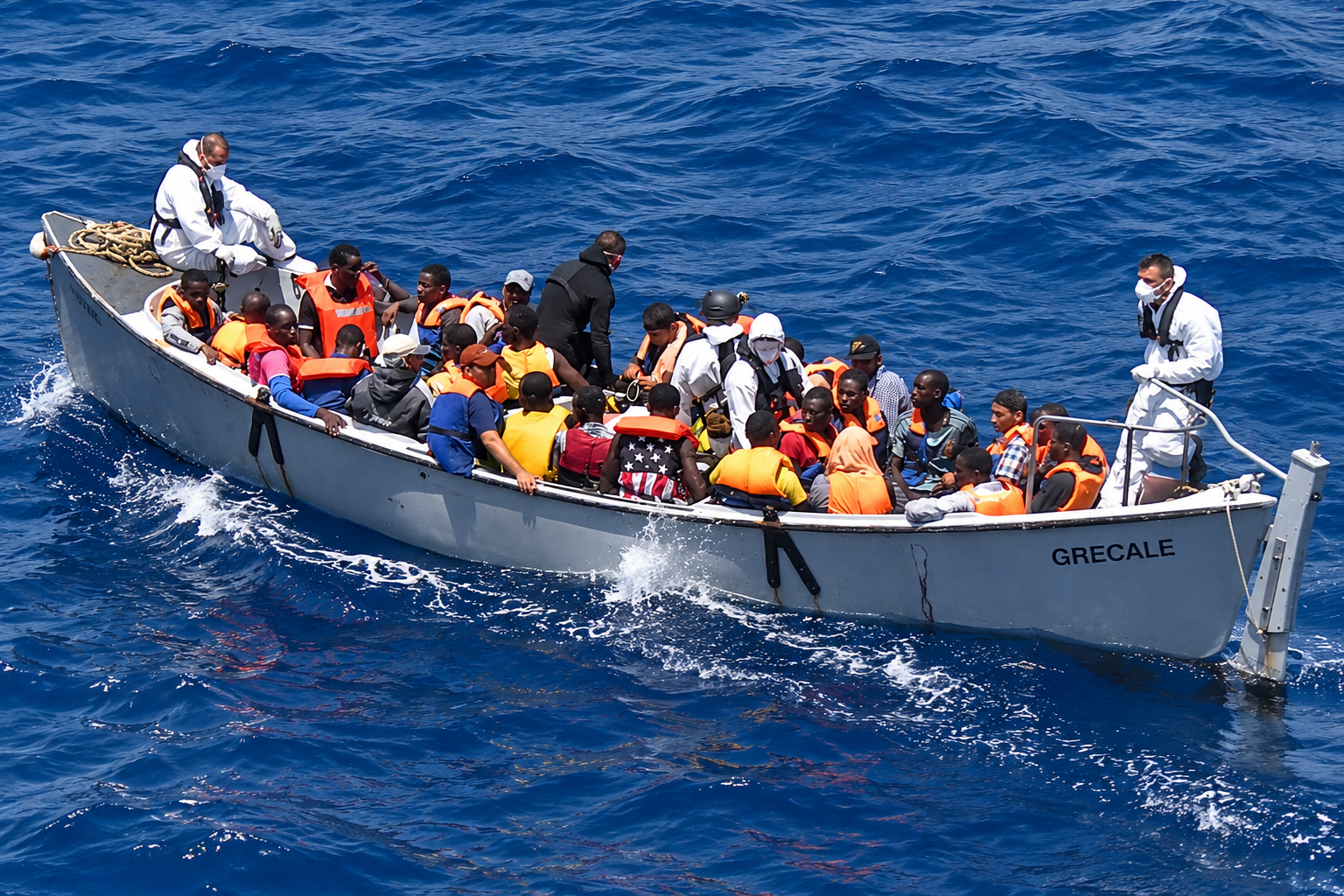
The transactional model that has defined Euro-Tunisian relations since 2023 is a strategic dead end. That July, the European Union signed a Memorandum of Understanding offering Tunis up to €164.5 million over three years, largely conditioned on stemming migration flows. The deal was billed as a “strategic partnership.” In practice, it outsourced border enforcement to a cash-strapped state whose own institutions were already fraying. The result has been neither strategic nor partnership. Tunisia’s coast remains a lethal departure point, migrant detention conditions have drawn condemnation from the European Parliament and the UN High Commissioner for Human Rights, and the underlying drivers of exodus — economic ruin, institutional decay, and a suffocating lack of opportunity — have only deepened.
The Mechanics of a Collapse Europe Keeps Misreading
Reducing Tunisia to a migration-control subcontractor ignores the mechanics of its collapse. Since 2021, Saïed’s consolidation of power has eroded judicial independence, targeted civil society, and scared off foreign investors. The evidence is in the exodus of capital and firms: Swiss electronics manufacturer Cicor divested its Tunisian facility in 2026, consolidating operations in Morocco, while the broader trend of de-industrialization has accelerated amid unpredictable decision-making and stalled IMF negotiations. Inflation, currency pressure, and a public debt exceeding 80% of GDP have choked the real economy. Meanwhile, roughly 62% of Tunisia’s electricity supply depends on Algerian gas, a dependency that has coincided with Tunis ceding its traditional foreign-policy neutrality to align with Algiers on regional disputes. The “Algerianization” of Tunisian diplomacy, as critics describe it, has further isolated the country from its European and Gulf partners at the worst possible moment.
No Security Behind Barbed Wire
Europe’s security cannot be built behind barbed wire in the Mediterranean. When a highly educated, digitally connected generation of Tunisians sees no horizon at home, the boats will keep leaving regardless of how many naval patrols Brussels funds. Tunisia’s youth unemployment rate remains among the highest in the region, and the country’s innovation potential — once the envy of the African continent — is being squandered by a regime more focused on settling scores with journalists and NGOs than on nurturing entrepreneurship. The recent rolling blackouts and water cuts, which have fueled street protests, are not mere administrative failures; they are symptoms of a state losing its capacity to govern.
The Price of Technocratic Caution
The price of European technocratic caution is already visible. Every economic indicator that deteriorates in Tunis translates into additional pressure on Lampedusa, Sicily, and the Italian mainland. Every institutional crack widens the space for human traffickers and regional spoilers. The notion that Europe can contain this through incremental aid disbursements and rigid conditionality is fantasy. Conditionality without credibility — demanding reforms while propping up a failing system — has produced the worst of both worlds: a Tunisian leadership that resents European interference while remaining dependent on European cash.
Toward a Co-Development Pact with Teeth
What is needed is not geopolitical charity, but a co-development pact with teeth. Four lines of action follow directly from the pattern of failure described above:
- Integrate Tunisia into European value chains, moving beyond the sterile logic of migration containment toward genuine industrial partnership in energy transition, digital infrastructure, and automotive components.
- Redirect financing toward the real economy — direct investment rather than budget support that disappears into opaque state accounts.
- Link European financing to measurable benchmarks in judicial reform, business climate, and human rights, rather than to vague promises.
- Speak with one voice about the dangers of Saïed’s authoritarian drift, rather than indulging it in silence for the sake of short-term border calm.
Conclusion
Tunisia has reinvented itself at every civilizational crossroads in its history. Its renaissance is still possible, but it cannot be willed into existence by Brussels bureaucrats managing Tunisia from a spreadsheet. For Europe, the Mediterranean is not an external border to be policed; it is a shared geopolitical space whose stability is indivisible. To ignore Tunisia’s distress today is to saw off the branch on which the security of the entire western Mediterranean rests. The hour is no longer for polite press releases or empty pledges. Saving Tunisia from its current tailspin is not an act of European generosity — it is an act of European self-preservation.
Dr Nizar Chaari is a senior consultant, strategist and media executive with over 30 years of experience in media, public affairs and pan-African leadership engineering. He is President of Tunivisions Group and founder of the Tunivisions Foundation and EPIK Leaders, a pan-African youth movement active in 15 countries. He specialises in grand strategy, digital transformation and organisational leadership.