Since Ansar Allah, commonly known as the Houthis, announced a maritime blockade against Saudi Arabia, there has been a significant escalation in the security crisis affecting one of the world’s most critical maritime corridors.
Framed as retaliation for the Saudi airstrike on Sana’a International Airport and what the Houthis describe as nearly twelve years of blockade against Yemen, the declaration extends the conflict far beyond Yemen’s borders and directly threatens international shipping through the Red Sea and the Gulf of Aden.
According to the Houthi statement, the blockade is based on the principle of “an eye for an eye”. The group argues that if Yemen remains under a land, sea and air blockade, Saudi Arabia will now face reciprocal maritime restrictions. The declaration also warns that any further Saudi escalation will trigger an even broader military response.
Maritime security company Ambrey has assessed that there is a realistic probability that the announced embargo could be enforced indiscriminately across the Red Sea and the Gulf of Aden. Shipping companies are therefore being advised to conduct comprehensive affiliation checks and reassess the risks of transiting the region, particularly for vessels with actual or perceived links to Saudi Arabia.
The Houthi announcement coincides with another alarming development: the resurgence of Somali piracy.
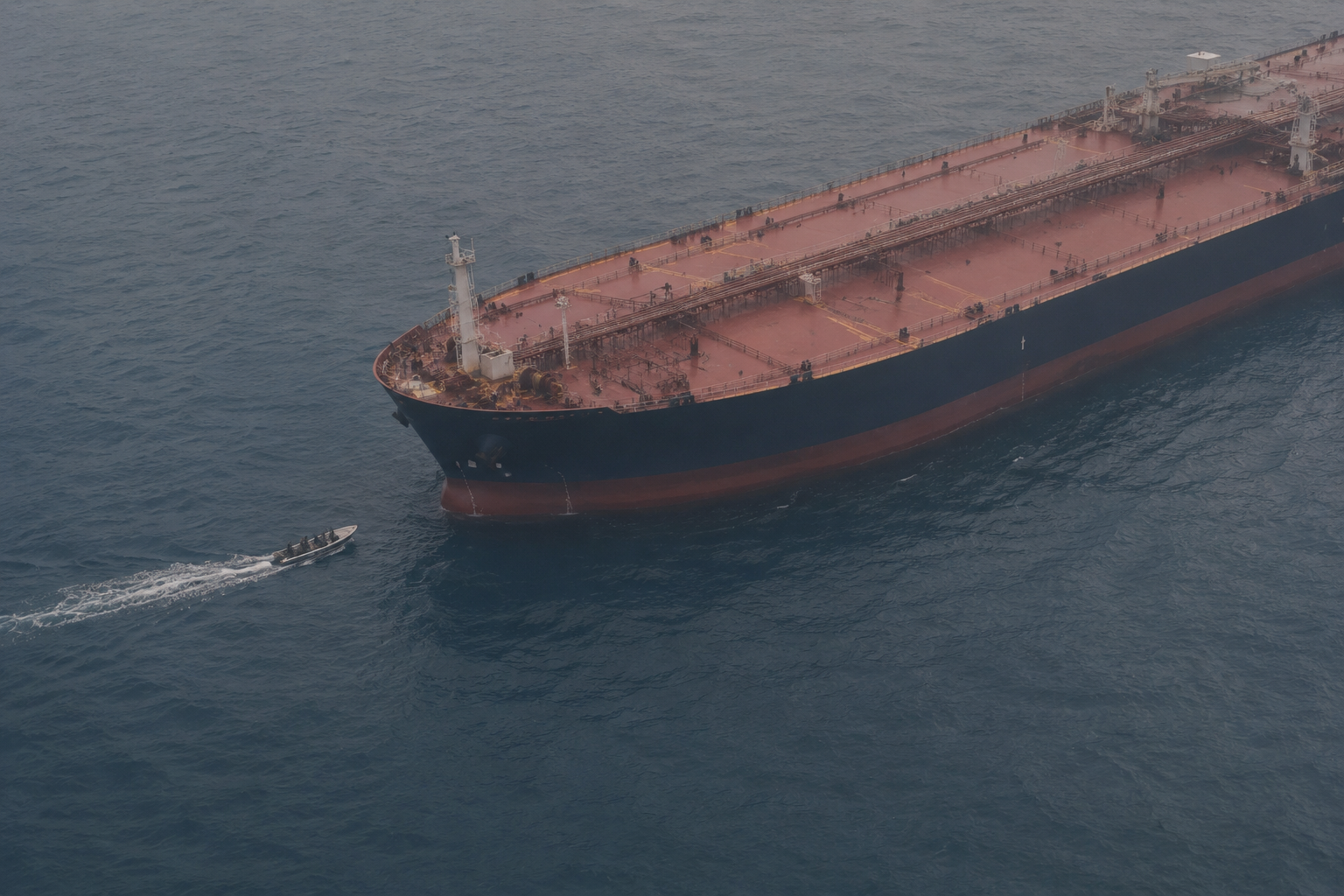
The hijacking of the MT ASANA, approximately 40 nautical miles off Mukalla, Yemen, by a Somali pirate group demonstrated that criminal networks are once again exploiting instability in the region. Although the vessel was released several days later, the incident highlighted the growing overlap between traditional piracy and the wider geopolitical crisis.
The pirate group reportedly consisted of members of several Somali clans under the leadership of Abdullahi Qasmahaysa. Their reported objective was to move the vessel towards Somalia’s central coast before its eventual release.
The simultaneous presence of Houthi military operations and renewed pirate activity creates an unprecedented security environment in which commercial shipping faces several threats at once.
Bab el-Mandeb: A Strategic Chokepoint Under Pressure
The Bab el-Mandeb Strait remains one of the world’s most strategically important maritime chokepoints, linking the Red Sea to the Gulf of Aden and serving as the southern gateway to the Suez Canal.
Any sustained disruption in this corridor directly affects global energy supplies and international trade. Combined with persistent instability around the Strait of Hormuz, the current situation places extraordinary pressure on two of the world’s most vital energy transportation routes.
For shipping companies, the principal risks now include:
- Houthi missile and drone attacks
- Enforcement of the declared maritime embargo
- Renewed Somali piracy
- Military operations involving regional and international naval forces
- Increased insurance premiums and operational costs
- Longer voyages caused by rerouting around the Cape of Good Hope
Global Economic Consequences
The convergence of these threats is likely to have far-reaching economic implications.
Shipping insurers are expected to maintain or increase war-risk premiums, while shipping companies may continue diverting vessels away from the Red Sea despite the significant increase in voyage duration and fuel consumption.
These disruptions ultimately affect global supply chains by increasing transportation costs, delaying cargo deliveries and placing upward pressure on the prices of energy, food and manufactured goods.
Implications for Mauritius and the Indian Ocean Region
For island nations such as Mauritius, which rely almost entirely on maritime imports for fuel, food, pharmaceuticals and consumer goods, the deterioration of maritime security presents a significant strategic concern.
Any prolonged disruption along the Red Sea, Bab el-Mandeb or the Strait of Hormuz will inevitably affect freight costs and import prices, increasing inflationary pressure on the Mauritian economy.
The situation also highlights the importance of strengthening regional maritime domain awareness, intelligence sharing, port security and cooperation among Indian Ocean nations to safeguard critical sea lines of communication.
Conclusion
The security crisis has evolved beyond a regional conflict into a broader competition over strategic maritime corridors.
The Houthi declaration of a maritime blockade against Saudi Arabia, combined with renewed Somali piracy and continuing instability across the Red Sea and the Strait of Hormuz, signals the emergence of a new phase in global maritime security.
For governments, naval forces and the commercial shipping industry, the priority is no longer responding to isolated incidents but managing an interconnected network of military, political and criminal threats that increasingly endanger one of the world’s most important maritime trade routes.
Author: Mauritius-based Bruneau Laurette is Director of DRCS Africa HQ and an elite defence and security consultant with over 25 years of experience in high-risk environments, maritime anti-piracy and port security. He has advised the governments of Mauritius, Seychelles and Tanzania, established specialist tactical units and trained law enforcement and correctional officers.