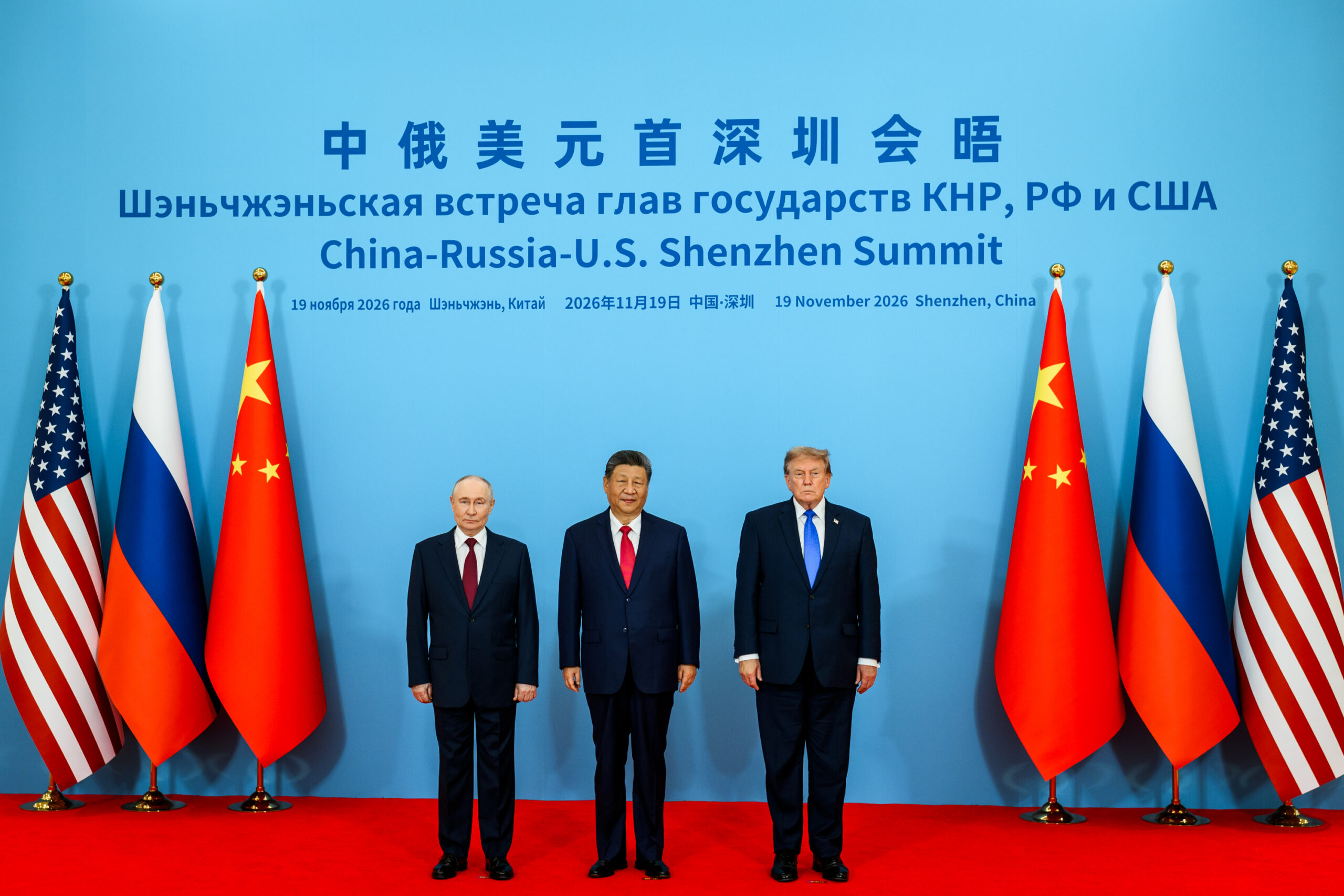
Image: White House, 19 November 2026
On 19 November 2026, US President Donald Trump, Russian President Vladimir Putin and Chinese President Xi Jinping held a historic trilateral summit in Shenzhen, China, on the sidelines of the Asia-Pacific Economic Cooperation (APEC) summit.
The three leaders adopted a joint declaration addressing international security, strategic stability, energy supplies, UN reform and the reduction of nuclear risks.
The emergence of a multipolar world
Beyond its diplomatic significance, the meeting reflects a broader transformation of the international system that has been unfolding for years.
The United States appears to be increasingly acknowledging the need to engage directly with Russia and China in a multipolar world, moving away from the unipolar international order that emerged following the collapse of the Soviet Union in the 1990s.
Meanwhile, Europe, particularly the European Union, has progressively lost geopolitical weight and influence. Its absence from these discussions illustrates its diminishing role in shaping the global security agenda.
Three powers shaping global security
The United States, Russia and China collectively possess enormous mineral and energy resources, extensive industrial and technological capabilities, the world’s largest nuclear arsenals and three of its most powerful militaries.
Their willingness to establish trilateral dialogue on international security represents a significant geopolitical development.
This does not necessarily signal the emergence of a new alliance. The three countries continue to have substantial differences in their geostrategic interests, and the declaration does not establish binding security arrangements.
Nevertheless, the Shenzhen summit provides a clear indication of how the global balance of power is being reconfigured and how the international order is increasingly moving towards multipolarity.
Author: Mikael Darbinian is a former US diplomat, geopolitical and military analyst and founder of Security Observer. He specialises in foreign policy analysis, military affairs and international security.